Today, in the age of artificial intelligence and the rapid digital transformation defining 2026, the question is no longer “Does my business need a digital presence?” The real question has become: “What digital format best represents my business and delivers the highest return on investment?”
Your first step toward building a strong digital presence starts with understanding the different types of websites available, and knowing how to put the right type to work for your sales and marketing goals.
In this comprehensive guide, we’ll walk you through exactly how to choose your next digital destination, and how Mosmer Agency can help turn that vision into a polished, professional reality.
Table of Contents
What Is a Website? And What’s the Difference Between an App and a Website?
A website is a collection of interlinked web pages hosted under a specific domain name, accessible to anyone around the world through a web browser (such as Google Chrome or Safari) without needing to download any software.
What’s the Difference Between an App and a Website?
While both serve your digital presence, the key difference lies in user behavior and how each one is accessed:
Website
Flexible and quick to access, a website shows up in search engines (SEO) and is built to attract new customers and introduce your brand identity with minimal effort from the user.
Mobile App
Downloaded from app stores (Google Play / App Store), an app relies on delivering a customized, immersive experience — push notifications, brand loyalty features, and so on — and is generally geared toward retaining existing customers and streamlining repeat transactions.
Why Do You Need a Website? The Importance of Having a Website for Your Business in 2026
Websites are no longer a luxury or a secondary display window — they’re the backbone of any business aiming for sustainable growth in 2026. Here’s why:
- Professional credibility: In 2026, customers don’t trust a brand without its own “digital address.” Your website is your official office on the internet.
- Full ownership and control: Unlike social media platforms governed by ever-changing algorithms and policies that could shut your account down at any moment, your website belongs entirely to you.
- An effective presence, 24/7: Your website works as a sales rep and customer service agent that never sleeps, taking orders and inquiries around the clock.
- Capturing search engine customers (SEO): Millions of searches happen every day; without a website, you’re literally invisible to a massive segment of your target audience.
What Are the Different Types of Websites?
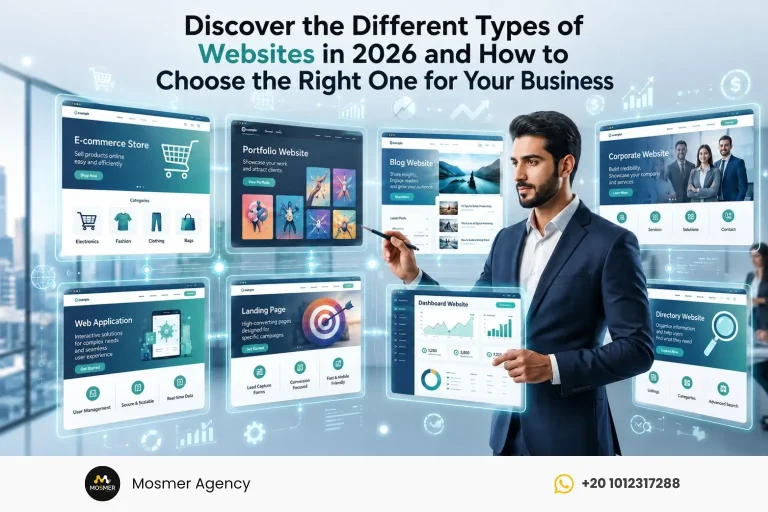
The different types of websites are as varied as the business goals and consumer behaviors behind them. Here’s a detailed map of the most prominent types in 2026:
E-commerce Websites (Online Stores)
Platforms dedicated to displaying and selling products or services online, include secure payment gateways and inventory and shipping management systems. Ideal for retail projects and both emerging and established brands.
Corporate & Portfolio Websites
Websites designed to introduce a company, its vision, services, and past work. They act as a polished resume that impresses businesses and prospective clients alike.
Educational Websites & Online Courses (E-learning)
Platforms dedicated to delivering training courses, managing students, uploading video and written lectures, and issuing certificates — used by training academies and digital schools.
Blogs
Websites focused on publishing written content and articles within a specific niche. They’re the most powerful tool for attracting visitors through search engines and showcasing expertise.
Travel & Tourism Websites
Platforms that showcase tourist destinations, hotels, and entertainment packages, relying heavily on high-quality photos and videos to attract travelers.
News Websites
Constantly updated portals for publishing news, analysis, and press reports, known for their ability to handle extremely high traffic volumes.
Service Websites (such as medical and clinic websites)
A digital front for doctors and medical centers, showcasing services, available equipment, and staff bios, while enabling direct communication with patients.
Consulting Websites
Built for legal, financial, or marketing consultants to present consultation packages and allow clients to book paid remote sessions.
Booking Websites
Integrated systems for booking hotels, flights, restaurants, or event tickets, relying on real-time calendars and upfront payment.
Landing Pages
A single, tightly focused page designed with high marketing precision to achieve one specific goal — such as collecting customer data or selling one exclusive product — forming the foundation of successful ad campaigns.
Government Websites
Official platforms for delivering digital services to citizens, distinguished by the highest levels of security and integration with massive databases.
Web Apps
Advanced websites that offer complex, interactive functionality similar to mobile apps, such as online photo-editing tools or cloud-based project management systems.
Social Media Websites
Platforms that let users create profiles, interact, and share content based on shared interests.
Entertainment & Gaming Websites
Platforms for streaming video/audio content (like streaming services) or offering interactive, browser-based games.
How Do I Choose the Right Type of Website for My Business?
Choosing the right type of website isn’t just about looks or budget — it’s about how well it can achieve your business goals and meet your customers’ needs. The right website for a service-based company isn’t necessarily right for an online store, and the needs of a startup differ from those of a large enterprise looking to expand digitally. That’s why it’s important to weigh several factors before deciding.
Define the Main Goal of the Website
Start with a simple question: what do you want the website to achieve?
If you want to sell products directly online, an e-commerce store is your best option.
If your goal is to introduce your company and its services, a corporate website will be more effective.
If you offer training courses or educational content, you’ll need a specialized e-learning platform.
If you rely on appointment bookings, such as clinics or beauty centers, an online booking website is the ideal solution.
The clearer your goal, the easier and more precise choosing your website type becomes.
Understand Your Target Audience
Your website’s design and functionality should match the behavior of the customers you’re targeting.
Ask yourself:
- Does your audience browse mostly from mobile phones or computers?
- Do they prefer to buy directly, or reach out first with questions?
- Do they need detailed information before making a purchase decision?
- Are they looking for quick access to a service, or comprehensive educational content?
Understanding these details helps you build a website that meets user expectations and boosts conversion rates.
Determine the Services and Functions You Need
Not all websites are alike in terms of capabilities. That’s why you need to define the functions your business needs from the very start, such as:
- Online payment.
- Appointment booking.
- Membership management.
- File uploads and downloads.
- Live chat.
- Integration with accounting or CRM systems.
- Multi-language support.
- User account creation.
Every additional function influences the type of website and how it needs to be developed.
Think About Future Expansion Plans
One common mistake is designing a website that only meets today’s needs, without considering the future.
If you’re planning to:
- Add new products.
- Open additional branches.
- Target international markets.
- Launch a mobile app down the line.
- Significantly grow your user base.
…then you need to choose a flexible technical architecture that allows for development and expansion without having to rebuild the website from scratch.
Consider Your Budget Without Sacrificing Quality
Website costs vary depending on type and features, but always choosing the cheapest option can lead to future problems like poor performance or difficulty updating the site.
It’s best to focus on the value the website will bring to your business, not just the initial implementation cost.
Focus on User Experience Before Aesthetics
An attractive design matters, but it isn’t the only factor behind a website’s success.
A successful website should offer:
- Easy navigation.
- Quick access to information.
- Clear presentation of services and products.
- Simple purchase or booking steps.
- Full compatibility with smartphones.
The better the user experience, the higher your chances of turning visitors into actual customers.
Make Sure the Website Is SEO-Friendly
Even the best website won’t deliver results if customers can’t find it through search engines.
So make sure your website is:
- Fast-loading.
- Well-structured.
- Compliant with SEO standards.
- Easy to crawl and index.
- Built to support marketing content and blogging.
These factors help increase visibility and consistently attract customers, without relying entirely on paid ads.
Consult a Specialized Agency to Assess Your Needs
Often, the real challenge isn’t the website design itself, but choosing the right digital solution from the start. That’s why working with a specialized company like Mosmer can help — analyzing your business, studying your goals and target audience, and guiding you toward the type of website that delivers the best return on investment.
Website Components
A website is made up of a set of core elements that work together to deliver a complete user experience and ensure the site runs efficiently. Whether you’re building a corporate website, an online store, an e-learning platform, or a service website, understanding these components helps you build a professional site capable of achieving your business goals.
Domain Name
The domain name is your website’s address on the internet — the link users type to reach your site, such as www.example.com.
Ideally, a domain name should be:
- Easy to remember and type.
- Connected to your business or brand name.
- As short and clear as possible.
- Suitable for your target audience and market.
Your domain is a key part of your project’s digital identity and directly affects how easily people can reach your website.
Web Hosting
Hosting is the space where your website’s files and databases are stored so visitors can access them over the internet.
Hosting quality directly affects:
- Page loading speed.
- Performance stability.
- Security level.
- The site’s ability to handle a large number of visitors.
It’s best to choose reliable hosting suited to your website’s size and operational requirements.
UI Design (User Interface)
The user interface is the visual side of the website, including colors, fonts, images, and how content is presented.
Professional design helps to:
- Capture visitors’ attention.
- Strengthen brand image.
- Make information easier to access.
- Increase the time users spend on the site.
UX Design (User Experience)
User experience focuses on how easy the website is to use and navigate.
It includes:
- Organizing menus and sections.
- Easy access to services or products.
- Clear contact and purchase buttons.
- Simplified booking or ordering steps.
The better the user experience, the higher your chances of converting visitors into customers.
Core Website Pages
Pages vary depending on the type of website, but most websites share a set of core pages, such as:
- Home page.
- About Us page.
- Services or Products page.
- Blog or News page.
- Contact Us page.
- FAQ page.
- Privacy policy and terms & conditions.
These pages help present information in an organized way and build visitor trust.
Content Management System (CMS)
A CMS is the system that lets you manage your website and update its content without needing extensive programming expertise.
Some of the most popular content management systems include:
- WordPress.
- Joomla.
- Drupal.
A CMS makes it easy to add pages, articles, and images, and make ongoing edits.
Database
A database is used to store website-related information, such as:
- Customer data.
- Products.
- Orders.
- Bookings.
- Published content.
It’s a core element in dynamic websites, online stores, and interactive systems.
Content
Content is what gives a website its real value, and includes:
- Introductory text.
- Articles.
- Images.
- Videos.
- Downloadable files.
Good content doesn’t just attract customers — it also helps improve your website’s visibility in search results.
Security Tools
With cyber threats on the rise, protecting websites has become essential.
Security measures include:
- An SSL certificate for data encryption.
- Systems to protect against hacking.
- Regular backups.
- Protection of customer data and online transactions.
Security builds user trust and keeps the website stable.
SEO Tools
These tools help improve a website’s visibility in search results and attract more organic visitors.
They include:
- Improving site speed.
- Organizing internal links.
- Optimizing pages for keywords.
- Improving titles and meta descriptions.
- Creating a sitemap.
Analytics and Tracking Tools
These tools let you monitor your website’s performance and understand visitor behavior to make more effective marketing decisions.
The most popular ones include:
- Google Analytics.
- Google Search Console.
They provide important data such as:
- Number of visits.
- Traffic sources.
- Most-viewed pages.
- Conversion rates.
Communication and Conversion Tools
These are the elements that help a visitor take the desired action on your website, such as:
- Contact forms.
- Direct call buttons.
- WhatsApp links.
- Request a quote.
- Online booking.
- Purchase and checkout.
The clearer and easier your communication tools are to use, the higher your chances of achieving your website’s goals.
Uses of Websites
Websites are no longer just a way to display information online — they’ve become an essential tool for managing business, marketing, connecting with customers, and driving growth across industries. With the rapid digital evolution of 2026, companies and institutions now rely on websites to carry out many tasks that once required a physical presence or complex traditional procedures.
Marketing and Brand Building
Websites are among the most powerful digital marketing tools, helping companies showcase their services and products professionally and strengthen their digital presence in front of potential customers. They also help build a strong brand identity through content, professional design, and a distinctive user experience.
Online Selling and Boosting Sales
Online stores are used to display products and complete sales and payments over the internet, allowing businesses to reach new customers both inside and outside their geographic area. They also make it easy to manage orders, shipping, and sales tracking efficiently.
Showcasing Services and Receiving Customer Requests
Many service-based companies rely on websites to present their services, highlight their advantages and pricing, and receive customer requests and inquiries directly — improving the customer experience and increasing the chances of closing deals.
Booking and Appointment Management
Websites are used across many sectors — medical clinics, beauty centers, hotels, and travel companies — to enable online booking and automatically organize appointments, reducing errors and saving time and effort for both customers and the business.
Remote Education and Training
Educational platforms and training websites have become an effective way to share knowledge and deliver courses, lectures, and tests online, allowing trainees to learn from anywhere, at any time.
Publishing Content and Information
Blogs, news websites, and online magazines are used to publish articles, news, reports, and educational content, helping organizations share knowledge and build an audience interested in their field.
Offering Consulting and Professional Services
Consulting websites allow individuals and companies to offer their professional services online — whether legal, financial, administrative, or marketing consulting — with the ability to book sessions and manage client communication with ease.
Customer Support and Better Communication
Websites provide multiple channels for connecting with customers, such as contact forms, live chat, knowledge bases, and FAQ pages, helping deliver faster, more professional support.
Managing Operations and Electronic Services
Many government bodies and large institutions use websites to deliver services electronically — issuing documents, submitting applications, paying fees, and tracking transactions without needing to visit official offices.
Collecting Data and Analyzing Customer Behavior
Websites allow business owners to understand customer needs and behavior through various analytics tools, helping them develop services, improve marketing campaigns, and make more accurate decisions.
Building Digital Communities
Some websites are used to create interactive communities that bring users together around shared interests or specialties, fostering interaction and the exchange of experience and information among members.
Supporting Expansion and Reaching New Markets
A website helps businesses go beyond geographic boundaries and reach new customers in different regions and markets, making it an effective tool for supporting expansion and boosting growth opportunities.
Quality Standards: How Do You Ensure Your Website Excels, Regardless of Type?
Despite the many different types of websites and their varying goals, there’s a core set of quality standards that every website needs in order to succeed and deliver the best results. A professional website isn’t judged by its design alone, but by how well it delivers a great user experience and achieves the business’s goals.
Here are the most important points to make sure your website has:
- Fast page loading, to ensure a smooth experience and reduce visitor drop-off.
- Compatibility with smartphones and various devices, since most users browse the internet from their phones.
- Easy browsing and navigation, so visitors can quickly find the information or services they need.
- Security and data protection, through an SSL certificate and modern protection systems.
- Search engine optimization (SEO), to improve visibility in search results and attract more potential customers.
- Clear, well-organized content that helps visitors understand your services or products and make decisions easily.
- Clear calls to action (CTAs), such as contact, request a quote, book, or buy.
- Room for future expansion and development, to keep up with business growth and add new features when needed.
- Integration with analytics and marketing tools, to track performance and continuously improve results.
The more you commit to these standards, the more likely your website is to succeed and become an effective tool for attracting customers and driving growth — regardless of the type of website or the industry it serves.
Criteria for Choosing the Best Website Design Company
Your website’s success largely depends on choosing a design company with the experience and ability to turn your business goals into a successful digital experience. When comparing companies, make sure to check the quality of their portfolio, mobile compatibility, attention to SEO, performance speed, security level, and ongoing technical support after launch.
At Mosmer Agency, we make sure to apply all of these standards by designing professional websites that combine an attractive look, an outstanding user experience, and modern technical solutions — helping businesses strengthen their digital presence and efficiently achieve their marketing and business goals.
Cost of Creating Websites
There’s no fixed cost for building websites, as prices vary depending on the type of website, project size, required features, and development technologies used. The cost of a simple corporate website differs from that of a full-featured online store, an e-learning platform, or an advanced booking system.
Some of the key factors that affect website cost include:
- The type of website and its goals.
- The number of pages and sections required.
- The level of design and customization.
- Additional features and functions, such as online payment, booking, or memberships.
- SEO compatibility.
- Hosting and domain name.
- Security and protection systems.
- Technical support and future maintenance services.
It’s best to think of your website as a long-term investment that helps attract customers, boost sales, and build a strong digital presence — not merely as an operational cost. At Mosmer Agency, we offer flexible website design solutions that fit different budgets and needs, with a commitment to quality and professional performance that helps your project achieve its digital goals.
Mosmer Agency: The Best Company for Designing All Types of Websites
When it comes to website design and development, choosing the right partner makes a real difference in the success of your digital project. Mosmer is a leading company in designing many different types of websites, combining technical expertise, creative design, and a deep understanding of the needs of businesses across various industries.
Mosmer Agency has experience delivering a wide range of website types — from corporate and portfolio websites to online stores, e-learning platforms, booking and consulting websites, medical and travel websites, and other specialized digital solutions. The team relies on the latest technologies and user experience standards to ensure fast, secure, SEO-friendly websites.
Mosmer’s role doesn’t stop at website design — it extends to offering consulting that helps clients choose the type of website best suited to their business, along with scalable solutions that support long-term business growth like Search Engine Optimization, Digital Marketing and Paid Ads. So if you’re looking for a professional website that combines quality, performance, and results, Mosmer Agency is a trusted choice to help you build a strong digital presence and achieve your business goals.
Turn Your Idea into a Professional Website with Mosmer Agency
Today, having a great idea or a promising project isn’t enough on its own — you need a professional platform that helps you reach your customers and turn your goals into tangible results. This is where Mosmer Agency comes in as a technical partner, helping you turn your idea into a complete website that reflects your brand identity and gives your customers an outstanding user experience.
At Mosmer Agency, we don’t see a website as just a set of pages on the internet — we see it as a marketing and investment tool that strengthens your digital presence and increases your chances of growth and expansion. That’s why every project starts with studying the nature of the business, understanding the target audience, analyzing competitors, and then designing the digital solution best suited to achieving your goals.
Whether you want to build an online store, a corporate website, an e-learning platform, a booking and consulting website, or any other type of website, Mosmer team works to develop a site that combines attractive design, fast performance, a seamless user experience, and SEO best practices. Contact us today and get 50% OFF website design services exclusively for website visitors.
Why Choose Mosmer Agency to Design Your Website?
- Professional designs that reflect your brand identity.
- Websites fully compatible with smartphones and various devices.
- High loading speed and stable performance.
- The latest security and data protection standards.
- SEO optimization built in from the development stage.
- Room to expand and add new features in the future.
- Ongoing technical support and follow-up after launch.
From Idea to Launch.. A Complete Success Journey
At Mosmer Agency, the website creation process goes through several carefully planned stages to ensure the best results:
- Analyzing the project and defining its goals.
- Studying the needs of the target audience.
- Designing the user interface and user experience.
- Developing the website using the latest technologies.
- Testing performance, speed, and security.
- Launching the website and monitoring its performance.
- Providing ongoing support and development.
Frequently Asked Questions About Types of Websites
What are the most popular types of websites?
The most popular different types of websites include online stores, corporate websites, blogs, e-learning platforms, booking websites, medical websites, news websites, landing pages, web apps, and other websites designed around the specific needs of each business.
What’s the best type of website for businesses?
It depends on the nature of the business. Service-based companies often benefit most from a corporate website, while companies that sell products need a full-featured online store that supports selling and payment online.
How do I know which type of website suits my project?
The right type of website is determined based on your project’s goals, target audience, the services or products you offer, and the functions you need, such as booking, online payment, or content management.
Can a website be developed further and have new features added later?
Yes, most websites can be developed and new features can be added later, such as an online store, booking systems, multi-language support, or integration with other apps and services.
What’s the difference between a website and an online store?
A website may be dedicated to introducing a company or presenting information and services, while an online store allows you to display products and complete purchases, payments, and order management online.
Do I need a website if I already have social media pages?
Yes. A website gives your business more professionalism and credibility, gives you full control over your content and data, and helps you appear in search engine results and attract new customers.
Are all websites compatible with smartphones?
They should be. Today, mobile compatibility is one of the most important success factors for any website, since most users browse the internet on mobile devices.
How long does it take to build a website?
Timelines vary depending on the type of website, project size, and required features. Simple websites may take just a few days, while larger, more complex projects need more time for development and testing.
Does the type of website affect its search engine ranking?
Search engine visibility doesn’t depend solely on the type of website, but on content quality, site speed, user experience, and the correct application of SEO standards.
Can Mosmer Agency design all types of websites?
Yes, Mosmer Agency offers complete solutions for designing and developing many different types of websites, including corporate websites, online stores, e-learning platforms, booking websites, and service websites — with a focus on quality, performance, and achieving clients’ digital goals.