You might offer the best product or service in your market, but if your website doesn’t show up when customers search for you on Google, you’re losing real opportunities every single day — often to competitors whose offerings are weaker, but whose visibility in search results is stronger.
This is where search engine optimization (SEO) comes in. It isn’t just a set of technical steps; it’s a long-term strategy that helps your website appear in front of customers at the exact moment they’re searching for your products or services, without relying entirely on paid ads.
Whether you run an online store or a company looking to grow, SEO is one of the most effective ways to increase traffic, attract potential customers, and achieve sustainable growth.
Table of Contents
What Is Search Engine Optimization (SEO)?
User behavior studies show that most clicks go to the first few results on a search page, while the chances of getting traffic drop sharply the further down a website ranks. That’s why SEO isn’t just about improving your page rankings — it plays a direct role in increasing the chances that potential customers actually reach your business.
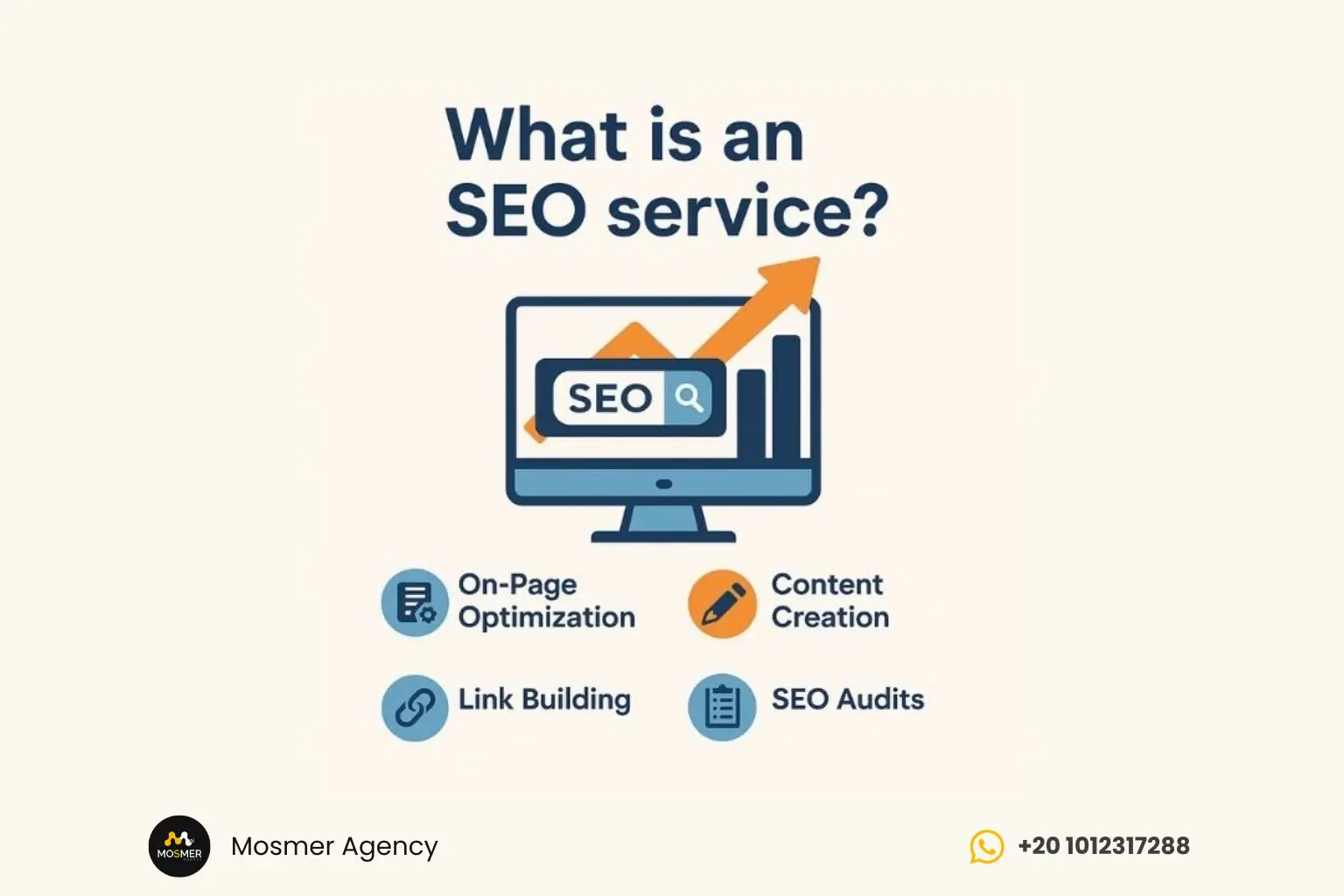
So, what is search engine optimization? SEO (Search Engine Optimization) is a set of strategies and techniques aimed at improving how your website appears in the organic (unpaid) results of search engines like Google, when users search for products, services, or information related to your business.
SEO covers many different aspects, including improving content quality, choosing the right keywords, developing the site’s technical structure, improving loading speed, building links, and enhancing the user experience — all so that search engines can understand your website and present it to users in the most relevant results.
But reaching the first page of Google doesn’t come down to a single step or a specific tool. It requires a complete strategy that combines analysis, execution, and continuous monitoring, while keeping up with search engine algorithm updates.
At Mosmer Agency, we deliver SEO services built on a well-researched methodology. We start by analyzing your website and your competitors, uncovering growth opportunities, then optimizing every technical and content element of the site, followed by continuous performance monitoring — all aimed at increasing organic traffic, improving keyword rankings, and delivering results that support your business’s long-term growth.
What Are Search Engines and How Do They Work?
Here’s something worth knowing from the start: Google processes billions of searches every day, analyzing millions of pages within fractions of a second to select the most relevant and highest-quality results to show the user. That’s precisely why the success of any SEO strategy starts with understanding how search engines actually work.
Search engines are intelligent systems designed to help users find the information, products, and services they’re looking for online. Google is the most widely used search engine in the world, alongside others like Bing and Yahoo — though Google holds the largest share of searches in most markets.
How Do Search Engines Work?
The process of displaying search results happens in three main stages:
1. Crawling
Search engines use programs known as crawlers or spiders to move between website pages, continuously discovering new or updated content.
2. Indexing
Once pages are discovered, search engines analyze and understand their content, then store it in a massive database known as the search index, making it eligible to appear in search results.
3. Ranking
When a user runs a search, search engine algorithms compare millions of indexed pages and rank them according to hundreds of factors — content quality, relevance to the keyword, site speed, user experience, link quality, and more — all with the goal of showing the user the most useful results.
Why Understanding How Search Engines Work Matters
The better you understand how search engines evaluate websites, the easier it becomes to develop your site in a way that aligns with those standards — which increases its chances of appearing in front of potential customers and generating consistent organic traffic.
At Mosmer Agency, we don’t rely on guesswork or outdated practices. We build SEO strategies based on how search engines actually operate, focusing on technical optimization, content quality, and user experience, to deliver sustainable results that keep pace with the latest Google updates.
How Does Google Rank Search Results? The Most Important SEO Ranking Factors
Here’s the truth: Google doesn’t rely on a single factor to rank websites. It uses hundreds of ranking signals to evaluate pages and determine whether they deserve a spot in the top results. The core purpose behind all these factors is to serve users the most useful, high-quality content.
That means ranking at the top of search results isn’t achieved through keyword stuffing or shortcuts — it’s achieved by building a website that delivers real value, offers an outstanding user experience, and meets the quality standards search engines look for.
Here are some of the most important search ranking factors:
High-Quality Content
Content is the foundation of any successful SEO strategy. The more original, useful, and comprehensive your content is in answering user questions, the greater its chances of ranking in search results.
Content Alignment with Search Intent
Using the right keyword isn’t enough on its own — your content also needs to address the real reason behind the search, whether the user is looking for information, a comparison, a service, or a product.
Improved User Experience
Google favors websites that offer a smooth browsing experience — fast navigation, easy access to information, and a design that adapts well across different devices.
Page Speed
Site speed directly affects user satisfaction and page rankings. The faster your website loads, the more likely visitors are to stay, which in turn improves your site’s performance in search results.
Mobile-Friendliness
Since most searches now happen on mobile devices, having a site that works well on smartphones has become one of the key factors influencing rankings.
Internal and External Links
Internal links help search engines understand your site’s structure, while high-quality external links strengthen your website’s credibility and authority.
Technical SEO
This includes optimizing your site’s structure, Sitemap and Robots.txt files, fixing crawling and indexing errors, and improving structured data (Schema) — all factors that help search engines understand your website more efficiently.
Trust and Credibility Signals (E-E-A-T)
Google relies on Experience, Expertise, Authoritativeness, and Trustworthiness as standards for evaluating content quality — especially in fields that influence important user decisions.
At Mosmer Agency, we optimize every SEO ranking factor, not just one. We start by analyzing your website, identifying its strengths and weaknesses, then build a comprehensive plan covering content, technical aspects, user experience, and site authority — to achieve sustainable results and greater visibility in search engines.
Types of SEO and Their Key Methods
Some people think SEO simply means writing articles. In reality, a website’s success depends on the integration of several types of search engine optimization. Even the best content may fall short if the site has technical issues or lacks credibility and quality backlinks.
A successful SEO strategy relies on multiple elements working together to improve your website’s visibility and boost its chances of ranking at the top of search results.
On-Page SEO
This focuses on optimizing all the elements within your website’s pages, helping search engines understand your content and present it to users.
It includes:
- Choosing the right keywords
- Writing professional meta titles and descriptions
- Optimizing page headings (H1–H6)
- Optimizing images and adding alt text
- Building internal links between pages
- Creating high-quality content that answers the searcher’s intent
Off-Page SEO
This focuses on building your website’s reputation beyond its own pages, aiming to increase its credibility with search engines by earning backlinks from quality websites, along with strengthening your brand’s overall digital presence.
Key methods include:
- Building natural backlinks
- Publishing shareable content
- Content marketing
- Improving online brand mentions
Technical SEO
This focuses on optimizing your website’s technical foundation to ensure easy crawling, indexing, and strong overall performance.
It includes:
- Improving site speed
- Ensuring mobile compatibility
- Setting up Sitemap and Robots.txt files
- Fixing indexing and crawling errors
- Optimizing structured data (Schema Markup)
- Strengthening site security with HTTPS
Local SEO
If your business targets a specific geographic area, local SEO helps you appear in local search results and on Google Maps when nearby customers search for your services.
It includes:
- Optimizing your Google Business Profile
- Ensuring consistent business information across platforms
- Collecting customer reviews
- Targeting local keywords
E-commerce SEO
This focuses on optimizing product pages, categories, and filters, along with the overall shopping experience, to increase your store’s visibility in search results and attract customers with real purchase intent.
At Mosmer Agency, we don’t rely on just one type of SEO. We build an integrated strategy that combines On-Page SEO, Off-Page SEO, Technical SEO, and Local SEO based on the nature of your business, ensuring the best possible results and long-term growth for your website.
How to Optimize Your Website for Search Engines: Step by Step
Website rankings on Google don’t improve overnight. SEO is an ongoing process built on analysis, execution, measurement, and refinement — and every step done correctly contributes to a stronger digital presence and more sustainable results.
If you want to improve your website’s visibility in search results, start with the following steps:
1. Conduct Keyword Research
Every successful strategy starts with identifying the keywords your target audience uses when searching for your products or services, focusing on keywords with a reasonable search volume that align with your business goals.
2. Create High-Quality Content
Aim to deliver content that answers users’ questions and provides real value, organizing information clearly and using subheadings and keywords naturally, without overdoing it.
3. Optimize On-Page SEO Elements
This includes writing compelling page titles, professional meta descriptions, optimizing H1 and H2 headings, adding internal links, optimizing images, and creating clear, easy-to-understand URLs.
4. Improve Your Website’s Technical Performance
Make sure your pages load quickly, your site works well on mobile devices, and you’re fixing crawling and indexing errors while optimizing your Sitemap and Robots.txt files — these factors directly affect your site’s performance in search engines.
5. Build High-Quality Backlinks
Earning links from trustworthy websites helps strengthen your site’s authority, as long as those links are natural and relevant to your industry.
6. Monitor Performance and Analyze Results
Use tools like Google Analytics and Google Search Console to track traffic, keyword rankings, and user behavior, then rely on that data to make continuous improvements.
7. Update Your Content Regularly
Search engines favor content that’s kept up to date, accurate, and aligned with changes in your industry, so make it a habit to review your website’s pages and add new information whenever needed.
At Mosmer Agency, we don’t rely on generic steps or one-size-fits-all solutions. We build an SEO plan based on an in-depth analysis of your business, your competitors, and your target keywords, then continuously monitor performance to ensure real, sustainable growth in search rankings and organic traffic.
Top SEO Tools to Analyze and Improve Your Website
SEO experts, including the team at Mosmer Agency, rely on data — not guesswork. That’s why SEO tools are an essential part of analyzing website performance, discovering growth opportunities, monitoring competitors, and continuously measuring the results of your optimizations.
SEO tools vary depending on their purpose — some help analyze site performance, others specialize in keyword research, tracking backlinks, or identifying technical issues.
Google Search Console
One of the most important free tools Google offers. It helps you track your website’s performance in search results, identify indexing issues, analyze the keywords driving traffic, and monitor click-through rate (CTR) and average page ranking.
Google Analytics 4 (GA4)
This tool helps analyze visitor behavior on your website, including traffic sources, the most-visited pages, and conversion rates — supporting decisions based on accurate data.
Ahrefs
One of the most powerful professional SEO tools, used for analyzing backlinks, studying competitors, researching keywords, and tracking your website’s rankings in search results.
SEMrush
Offers a complete toolkit for competitor analysis, SEO campaign management, keyword tracking, comprehensive site audits, and discovering optimization opportunities.
Screaming Frog SEO Spider
This tool crawls your entire website to uncover technical issues such as broken links, duplicate content, and title or description problems, making it a core tool in Technical SEO.
Google Keyword Planner
Used for keyword research, showing search volume and competition level, and helping shape your content strategy around the right target keywords.
PageSpeed Insights
Measures your website’s speed on both desktop and mobile devices, offering practical recommendations to improve performance and user experience — two factors that matter a great deal for search rankings.
Having access to these tools doesn’t guarantee success on its own. The real value lies in analyzing the data they provide and using it to make the right decisions.
Why Is SEO Important for Websites and Online Stores?
Paid ads can bring visitors to your website, but only for as long as your campaign budget lasts. SEO, on the other hand, builds a sustainable source of traffic by helping your site appear in search results whenever customers look for your products or services.
That means the role of search engine optimization goes far beyond improving your Google ranking — it directly impacts your business growth, increases potential customers, and strengthens trust in your brand.
Increased Organic Traffic
SEO helps attract visitors who are already searching for what you offer, making that traffic far more valuable than untargeted visits.
Reaching Customers at the Right Time
Your website appears exactly when a user is searching for a product or service related to your business, increasing the likelihood of turning them into an actual customer.
Building Trust and Credibility
Users tend to trust websites that appear in the top results, so improving your ranking has a positive effect on your brand’s image.
Improved User Experience
SEO involves improving site speed, organizing content, simplifying navigation, and ensuring mobile compatibility — all factors that enhance the visitor experience and increase the chances they’ll stay on your site.
Lower Customer Acquisition Cost
As organic traffic grows, your reliance on paid ads as the sole source of customers decreases, helping improve your marketing return on investment.
Supporting E-commerce Growth
For online stores, SEO helps improve the visibility of product and category pages in search results, attracting customers with genuine purchase intent — which translates into higher sales.
Long-Term Results
While SEO takes time to show results, its impact lasts far longer when implemented correctly, making it a sustainable investment in your business’s growth.
Search engine optimization remains one of the most important digital marketing channels for attracting customers. If you’d like to understand the bigger picture before diving into SEO, it’s worth exploring the definition of marketing and its key strategies.
At Mosmer Agency, we help companies and online stores harness the power of SEO through well-researched strategies designed to increase qualified traffic, improve keyword rankings, and turn Google visibility into real business growth opportunities.
SEO vs. SEM: What’s the Difference? And Which Is Better for Your Website?
One of the most commonly confused concepts is the difference between SEO and SEM. While both aim to increase your website’s visibility in search engines, they differ significantly in how they work, the results they deliver, and their cost.
Search engine optimization (SEO) focuses on improving your website and its content to appear in the free, organic search results, while search engine marketing (SEM) relies on paid advertising, such as Google Ads, to appear at the top of search results in exchange for a cost per click (PPC).
SEO vs. SEM at a Glance
| Search Engine Optimization (SEO) | Search Engine Marketing (SEM) |
| Relies on organic (free) results | Relies on paid advertising |
| Takes time to build results | Delivers fast visibility once the campaign launches |
| Focuses on sustainable growth | Better suited for short-term campaigns and offers |
| No cost per visit | You pay for every click on the ad |
| Builds long-term trust in your website | Visibility usually stops when the budget runs out |
Which Is Better for Your Website?
There’s no single answer that fits every business, since the right choice depends on your goals, budget, and level of competition.
If you’re after quick results — like launching a new product or boosting sales within a specific timeframe — SEM may be the better fit.
But if your goal is to build a strong, lasting presence in search results and reduce your dependence on paid ads over time, SEO is the smarter long-term investment.
In many cases, businesses see the best results by combining SEO and SEM within a single, integrated digital marketing strategy — ads deliver immediate visibility, while SEO builds sustainable growth over time.
At Mosmer Agency, we help you choose the strategy that best fits your business goals, and we can also combine SEO services with Google Ads campaigns to maximize your return on investment and reach customers at every stage of the buying journey.
Start Your Journey to the Top of Search Results with Mosmer Agency
If you’re ready to turn SEO from a handful of website tweaks into a real strategy that attracts customers and grows your business, Mosmer Agency offers complete SEO solutions built on data analysis and a deep understanding of your business and competitors.
At Mosmer Agency, we handle every aspect of search engine optimization — starting with keyword research and search intent analysis, through content optimization and On-Page SEO, technical performance improvements, link building and site authority growth, all the way to ongoing performance tracking and analysis.
Whether you run a company, an online store, or a new venture, we build an SEO strategy tailored to your goals, your target audience, and your competitive landscape — designed to increase your visibility on Google, attract qualified traffic, and turn organic visits into real growth opportunities.
Get in touch with Mosmer Agency today, and let’s build an effective SEO strategy that boosts your brand’s visibility on Google and turns search results into real, sustainable growth.
Frequently Asked Questions
How long does it take for SEO to show results?
There’s no fixed timeframe — results depend on your website’s age, the level of competition, content quality, and technical health. In many cases, positive signs start appearing within a few months of following a solid SEO strategy.
Can you rank in search results without running ads?
Yes, and that’s the core goal of search engine optimization. By optimizing your website, content, and technical elements, you can achieve visibility in the organic results and generate consistent traffic without paying for every click.
Is SEO suitable for small businesses?
Absolutely. SEO helps small businesses compete in search results, reach their target customers, and build a strong digital presence, even with a marketing budget smaller than their competitors’.
Do I still need SEO if I’m already running Google Ads?
Yes. Ads give you quick visibility, while SEO helps you build a lasting presence in the organic results. Combining both usually delivers the best results in both the short and long term.
Can I do SEO myself?
You can apply some SEO basics yourself, like improving content and choosing keywords, but achieving competitive results requires technical expertise, ongoing analysis, and staying on top of search engine updates — which is exactly what specialized agencies provide.
Why choose Mosmer Agency for SEO services?
At Mosmer Agency, we build SEO strategies based on data analysis, competitor research, and a clear understanding of your business goals, while optimizing every technical and content element and delivering regular reports to measure performance — all aimed at achieving sustainable growth in traffic and potential customers.
Sources: