You might have a great product, a strong marketing plan, and even an audience ready to buy — but choosing the wrong type of online store can still cost you sales and slow down your business’s growth.
That’s because success in ecommerce doesn’t come down to simply building a store. It starts with choosing the model that fits the nature of your business, how you sell, and what your customers need. And with so many different types of ecommerce websites and platforms available, the decision can get complicated fast if you don’t know the differences between them.
In this guide, you’ll learn about the different types of ecommerce websites, the advantages of each, and more.
Table of Contents
What Is an Ecommerce Website?
Statistics show that hundreds of millions of people around the world shop online, which means having an ecommerce website is no longer just a competitive edge — it’s a necessity for any business that wants to grow and reach more customers.
An ecommerce website is a digital platform that lets individuals and businesses showcase and sell products or services online, offering a complete shopping experience that starts with browsing products, moves through checkout and payment, and ends with shipping and after-sales service.
Unlike physical stores, an ecommerce website lets customers shop anytime, from anywhere, while giving business owners the opportunity to reach a wider audience without being limited by location or business hours.
Ecommerce websites differ in design and how they operate depending on the nature of the business, which is why different types of ecommerce websites exist to fit the needs of different projects, whether they’re selling physical products, services, digital products, or even online marketplaces that bring multiple sellers together on one platform.
An ecommerce website’s success doesn’t come down to an attractive design alone — it also depends on fast performance, ease of use, secure payments, and user experience, along with integration with marketing, shipping, and order management tools.
At Mosmer Agency, we believe a successful ecommerce website is one that combines professional design, a smooth user experience, and a strong technical foundation. That’s why we build online stores that help business owners increase sales, build customer trust, and achieve sustainable growth.
Why Your Business Needs an Ecommerce Website
An ecommerce website has become one of the most important digital assets for any business today. It doesn’t just showcase products or services — it works as a complete branch of your business, available to customers around the clock, helping you expand and drive sales without the constraints of location or time.
A customer might visit your online store several times before deciding to buy, but if they run into a poor user experience or a slow website, they’ll likely move on to a competitor within seconds. So it’s not enough to simply have an ecommerce website — it needs to be designed to turn visitors into customers. Here are some of the key benefits of building an ecommerce website:
Reaching More Customers
An ecommerce website lets you reach customers inside and outside your city, and even in entirely new markets, without needing to open additional branches.
Increasing Sales Around the Clock
Unlike physical stores, an ecommerce website accepts orders at any time, giving customers the freedom to buy whenever they want and increasing your chances of making a sale.
Reducing Operating Costs
Having an ecommerce website helps reduce many of the expenses tied to running a physical store, while letting you manage sales, inventory, and orders more efficiently.
Improving the Customer Experience
With a professional design, fast browsing, secure payment methods, and a variety of shipping options, customers feel more comfortable and confident during checkout — which translates into higher conversion rates.
Collecting and Analyzing Customer Data
An ecommerce website gives you valuable insight into visitor behavior, best-selling products, and purchase rates, helping you make more accurate marketing and business decisions.
Supporting Digital Marketing Efforts
An ecommerce website is the launchpad for all your marketing campaigns, whether through search engines, Google Ads, or social media, turning visits into real sales opportunities.
At Mosmer Agency, we don’t design ecommerce websites just to showcase products — we build stores that support your business growth, deliver a professional shopping experience, and integrate with marketing and analytics tools, helping you get the best possible return on your digital investment.
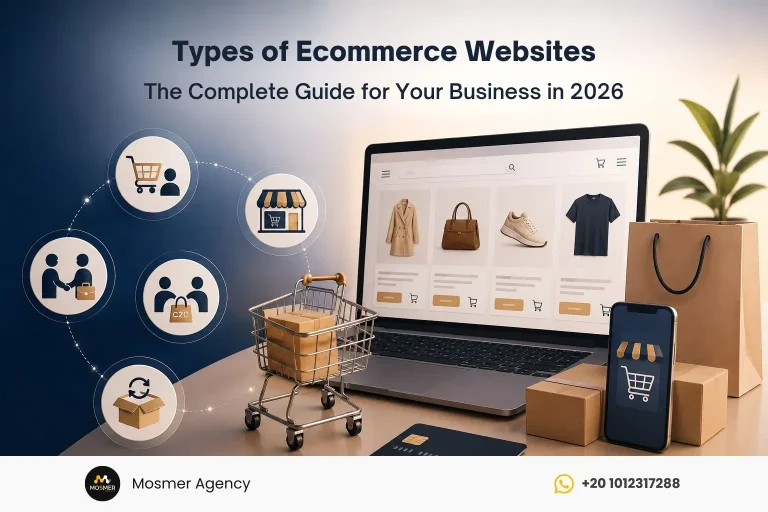
What Are the Types of Ecommerce Websites?
Choosing the type of ecommerce website is one of the most important decisions affecting your project’s success. Even with great products and a strong marketing plan, choosing a store type that doesn’t fit your business can limit your growth and hurt the customer experience.
There’s no single type that fits every project, which is why different types of ecommerce websites exist to meet the needs of different businesses. Choosing the right type depends on the nature of your products or services, your target audience, and how you plan to sell.
Physical Products Store
One of the most common types of ecommerce websites, used for selling physical goods such as clothing, electronics, cosmetics, and furniture. This type requires inventory management, shipping, and electronic payment methods.
Digital Products Store
Dedicated to selling products that can be downloaded immediately after purchase, such as ebooks, online courses, designs, templates, software, and digital files — with no need for shipping.
Service Store
Used by businesses and individuals offering services such as consulting, design, marketing, programming, and appointment booking, allowing customers to request or book a service and pay online.
Marketplace
This type differs from traditional stores because it brings together a large number of sellers on a single platform, with the platform managing sales, payments, and communication between sellers and customers. Well-known examples include Amazon and Noon.
Subscription Store
Relies on a monthly or annual subscription model, used by digital content providers, educational platforms, SaaS products, and some delivery services and recurring products.
B2B Store (Business-to-Business)
Focused on selling products or services to businesses and organizations, often including features such as quote requests, custom pricing, and business account management.
B2C Store (Business-to-Consumer)
The most common type, selling products or services directly to the end consumer, with a focus on a simple shopping experience and fast order fulfillment.
A store’s success doesn’t come from choosing the most popular type — it comes from choosing the type that fits your project’s goals and your customers’ needs. That’s why Mosmer Agency starts by studying your business and its needs, then recommends the most suitable type of ecommerce website before moving into design and development, ensuring we build a store capable of growing and driving sales.
What Are the Best Ecommerce Platforms?
There’s no single ecommerce platform that’s best for everyone. A store’s success depends less on the platform’s name and more on how well it fits your project’s needs, your number of products, and your future growth plans.
After learning about the different types of ecommerce websites, the next step is choosing the platform your store will be built on. Ecommerce platforms vary in ease of use, cost, customization flexibility, and available add-ons, so it’s worth comparing them before making a decision.
Shopify
One of the most popular ecommerce platforms globally, known for its ease of use, quick setup, and large selection of templates and apps — making it a good fit for small and medium-sized projects, especially those looking to launch quickly.
WooCommerce
If you’re using WordPress, WooCommerce is one of the best options, giving you great customization flexibility along with thousands of plugins to develop your store around your business’s needs.
Magento (Adobe Commerce)
Magento targets larger stores that need advanced capabilities and high scalability, though it requires more technical expertise compared to other platforms.
OpenCart
OpenCart is an open-source platform that offers solid capabilities for managing products and orders, making it suitable for many projects looking for an affordable solution with room for customization.
Salla
Salla is a popular platform in Saudi Arabia, offering complete tools for launching ecommerce websites, with support for local payment and shipping methods and ease of use without needing programming experience.
Zid
Zid offers solutions tailored to store owners in the Saudi market, with the ability to manage products, orders, and reports, along with integration with a wide range of logistics and marketing services.
Custom Ecommerce Platform
In some cases, ready-made platforms aren’t enough, especially when a project needs unique features or specific integrations with internal systems. In these situations, developing a fully custom ecommerce website is the best option for achieving complete flexibility and future scalability.
At Mosmer Agency, we don’t recommend the same platform to every client. We start by analyzing the nature of your project, your number of products, your budget, and your future plans, then help you choose the platform that delivers the best performance and the highest return on investment.
How to Choose the Right Type of Ecommerce Website for Your Business
One of the most common mistakes business owners make is choosing a type of ecommerce website based on what their competitors use, when the right decision should be based on their own project’s needs, not other people’s experiences.
After learning about the different types of ecommerce websites, the most important question remains: which type is right for your business? The answer isn’t about one type being better than another — it’s about how well it fits the nature of your business, your goals, and your future plans.
Before making a decision, ask yourself the following questions:
What Are You Selling?
If you’re selling physical products, you’ll need a store that supports inventory management and shipping. If you offer services or digital products, your store’s needs and required features will be different.
Who Is Your Target Audience?
Understanding your customers helps you choose a store that delivers a shopping experience suited to them, whether they’re individuals (B2C), businesses (B2B), or an audience looking for subscriptions and ongoing services.
What’s the Size of Your Project?
A ready-made solution might be a good fit for startups, while medium and large businesses need a more flexible store that supports expansion and future features.
What’s Your Budget?
A store’s cost isn’t just about design — it also includes hosting, development, updates, and integration with payment and shipping methods, so it’s important to choose a solution that fits your current budget and future plans.
Are You Planning to Expand?
If you’re planning to add new products, expand into other markets, or connect your store to management and inventory systems, it’s best to choose a store that can scale from the start.
Choosing the right type saves you a lot of time and money down the road, and gives your project a strong foundation for growth. That’s why, at Mosmer Agency, we don’t jump straight into design — we analyze the nature of your business, understand your goals, and then help you choose the most suitable type of ecommerce website, ensuring we build a store that serves your project today and keeps up with your growth in the future.
Which Is the Better Ecommerce Website: Custom or Ready-Made?
Many business owners believe a custom platform is always better, while others think ready-made platforms cover all their needs. The truth is, the best choice is the one that fits your project’s size, budget, and future plans.
When building an ecommerce website, you’ll typically face two main options: relying on a ready-made platform like Shopify, Salla, or Zid, or investing in a custom ecommerce website built specifically around your project’s needs. Each option has its own advantages and challenges.
| Ready-Made Platforms | Custom Platforms |
| Fast to launch and implement. | Complete flexibility in design and features. |
| Lower upfront cost. | Well suited to medium and large projects. |
| Doesn’t require extensive technical expertise. | Ability to develop any feature based on project needs. |
| Updates and maintenance provided by the platform. | Easier integration with internal systems, ERP, and CRM. |
| Relatively limited customization options. | Higher cost and longer implementation time. |
If you’re just starting your project and looking for a fast, affordable launch, a ready-made platform can be a practical choice. But if your project has specific requirements or needs significant scalability, a custom store gives you greater flexibility and full control over every detail.
At Mosmer Agency, we don’t point every client toward the same option. We study the nature of your business, your number of products, the scale of your operations, and your future growth plans, then help you choose the solution that delivers the best value for your investment, whether that’s a ready-made or a custom store.
Ecommerce Website Design Pricing
There’s no fixed price for designing an ecommerce website, because the cost doesn’t depend on design alone — it’s affected by dozens of details, such as the type of store, the number of pages, the required features, software integrations, and future expansion plans.
“How much does it cost to design an ecommerce website?” is one of the most common questions business owners ask, but the answer varies from project to project, since every store has different requirements.
Some of the most important factors that affect ecommerce website design costs include:
Type of Ecommerce Website
The cost of a store selling a limited number of products differs from that of a multi-vendor marketplace, a subscription-based store, or a platform for selling digital products.
Platform Used
You might rely on a ready-made platform like Shopify, WooCommerce, or Salla, or choose to build a fully custom store — each option comes with different costs for setup, development, and maintenance.
UI/UX Design
The more professional and user-experience-focused the design, the higher the store’s value — but this also helps improve conversion rates and increase sales.
Features and Integrations
Adding multiple payment methods, connecting shipping companies, inventory management systems, and accounting or CRM software are all factors that affect the final cost.
Number of Products and Pages
The workload increases with a higher number of products, or if the store needs custom pages, multiple sections, or support for different languages and currencies.
Technical Support and Future Development
It’s important to look beyond the initial build cost and consider support services, updates, protection, and the ability to develop the store further as your business grows.
At Mosmer Agency, we don’t offer random pricing or one-size-fits-all packages. We start by understanding your project and its needs, then provide a proposal that fits your goals and budget, with a focus on building an ecommerce website that delivers a real return on your investment — not just a page for showing off products.
How to Design a Successful Ecommerce Website for Your Business
User experience research shows that first impressions of any website or online store form within a matter of seconds, which means a store can lose a customer before they even browse the first product if the user experience is slow or uncomfortable.
Designing a successful ecommerce website isn’t just about choosing attractive colors or a modern template — it’s about building a complete shopping experience that lets customers move easily from browsing products to completing a purchase. The smoother that journey, the higher your conversion rates and the greater your chances of making sales.
To design a professional ecommerce website, make sure to keep the following points in mind:
A Professional Design That Reflects Your Brand Identity
Your store’s design should reflect your business’s identity through colors, fonts, images, and how products are displayed, strengthening customer trust and leaving a professional impression.
Improving the User Experience (UX)
Navigation between pages should be simple, with clear categories, an effective search bar, and easy access to products, so customers don’t feel overwhelmed while shopping.
Store Loading Speed
Website speed is a core factor in any ecommerce website’s success, since it affects the user experience, search engine rankings, and checkout completion rates.
Mobile Compatibility
Since a large share of online shopping happens on mobile phones, your store needs to perform efficiently across all devices and screen sizes.
Offering Various Payment and Shipping Options
The more reliable payment and shipping options you offer, the easier the shopping experience becomes, and the lower your cart abandonment rate.
Focusing on Search Engine Optimization (SEO)
Optimizing product pages, titles, descriptions, site speed, and store structure helps your store appear in search results and attract steady, free traffic.
Tracking Performance and Continuously Improving Your Store
The work doesn’t end once your store launches. You need to monitor customer behavior, analyze data, and make regular improvements to keep sales growing.
At Mosmer Agency, our role doesn’t stop at designing a professional-looking ecommerce website. We focus on building a store that achieves your project’s goals by combining user experience, SEO, fast performance, and integration with marketing tools, turning your store into a real tool for increasing sales and driving growth.
The Most Important Tools and Technologies You Need for a Successful Ecommerce Website
An ecommerce website’s success doesn’t depend on design alone — it depends on the technical system running behind it. Even the best stores can lose customers if payment options are limited, order management is disorganized, or security isn’t sufficient.
That’s why, when building an ecommerce website, it’s important to rely on tools and technologies that help improve the customer experience, simplify day-to-day operations, and support your project’s growth over time.
Payment Gateways
Payment gateways provide a fast, secure checkout experience, letting customers use various payment methods such as bank cards and digital wallets, which increases checkout completion rates.
Shipping and Delivery Companies
Integrating with shipping companies helps you manage orders efficiently, track shipments, and offer delivery options that fit your customers’ needs.
Inventory Management Tools
These tools help you track available quantities, automatically update inventory, and avoid issues like running out of stock or overselling.
Data Analytics Tools
Tools like Google Analytics and Google Search Console help you understand visitor behavior, analyze traffic sources, and measure store performance to make data-driven decisions.
SEO Tools
Used to improve the visibility of product and category pages in search results, increasing your chances of getting free, targeted traffic.
Customer Relationship Management (CRM) Systems
These help organize customer data, track purchases, improve customer service, and launch more effective marketing campaigns.
Security Certificates (SSL)
An SSL certificate is one of the basics of any ecommerce website, protecting customer data and payment transactions while strengthening visitor trust and improving your store’s credibility with search engines.
At Mosmer Agency, we make sure to equip your ecommerce website with all the tools and technologies it needs to succeed, choosing the right solutions for your project to ensure a professional user experience, easy management, and scalability as your business grows.
Ecommerce Website Design Services
Designing an ecommerce website is the start of the journey, not the end of it. A store that actually drives sales doesn’t rely on looks alone — it depends on the integration between design, development, user experience, marketing, and ongoing analysis.
That’s why professional ecommerce website design services go beyond simply creating pages to showcase products — they include a complete set of solutions that help launch a professional store capable of competing and growing.
Professional ecommerce website design services include:
Professional UI/UX Design
Designing a store that reflects your brand identity and offers an easy user experience that encourages visitors to complete their purchase journey.
Ecommerce Website Development
Building a fast, secure store that’s compatible with different devices, with scalability and future features taken into account.
Connecting Payment and Shipping Methods
Integrating your store with payment gateways and shipping companies to provide a smooth, secure shopping experience for customers.
Search Engine Optimization (SEO)
Optimizing your store’s structure and product pages to make them easier to index in search engines, increasing their visibility to potential customers.
Connecting Analytics Tools
Setting up tools like Google Analytics and Google Search Console to track store performance, analyze customer behavior, and measure results.
Technical Support and Maintenance
Continuously monitoring your store’s performance, carrying out necessary updates, and resolving any technical issues to keep operations stable.
Development and Expansion
Adding new features, connecting external systems, and improving the user experience as your business grows.
At Mosmer Agency, we offer complete solutions for designing and developing ecommerce websites, starting with studying your business and choosing the best platform, moving through design and development, all the way to SEO, analytics integration, and performance management. Our goal isn’t just to build an ecommerce website — it’s to build a professional sales platform that helps you increase sales, strengthen the customer experience, and achieve sustainable growth.
Start Your Ecommerce Website With Mosmer Agency
If you’re looking for a partner with real experience designing and developing ecommerce websites, Mosmer Agency offers complete solutions tailored to your project, whether you’re launching your first store or developing an existing one.
We rely on the latest technologies and best practices in ecommerce website design, with a focus on performance speed, user experience, SEO, and integration with payment and shipping systems, to ensure your store is ready to grow and compete.
Get in touch with the Mosmer team today, and let us help you build a professional ecommerce website that turns your visitors into loyal customers and gives your project a real shot at success in the world of ecommerce.
Frequently Asked Questions About Types of Ecommerce Websites
What are the types of ecommerce websites?
The types of ecommerce websites include physical product stores, service stores, digital product stores, marketplaces, subscription stores, B2B stores, and B2C stores. Each type varies based on the nature of the business and its target audience.
How do I choose the right type of ecommerce website?
The choice depends on several factors, most importantly the nature of your products or services, your target audience, the size of your project, your budget, and your future expansion plans. It’s best to study your project’s needs before starting the design process.
What’s the best platform for building an ecommerce website?
There’s no single platform that fits every project. Shopify, WooCommerce, Salla, or Zid can all be good options depending on your business’s needs, while some projects need a custom ecommerce website that offers greater flexibility.
Should I choose a ready-made or a custom ecommerce website?
If you’re starting a new project and looking for a fast launch, ready-made platforms can be a good option. But if your project needs custom features or significant scalability, it’s better to invest in a custom ecommerce website.
How much does it cost to design an ecommerce website?
Costs vary depending on the type of store, the platform used, the number of products, the design, the required features, and integration with payment and shipping systems, so there’s no fixed price that fits every project.
What are the most important factors for ecommerce website success?
An ecommerce website’s success depends on choosing the right type, a professional design, fast performance, a great user experience, secure payment methods, SEO, and an effective digital marketing plan.
Can an ecommerce website be developed after launch?
Yes, you can add new products, improve the design, connect additional systems, or improve performance, which is why it’s recommended to choose a store or platform that supports growth as your project expands.
Why choose Mosmer Agency to design your ecommerce website?
At Mosmer Agency, we don’t just design an attractive ecommerce website — we build a complete store that achieves your project’s goals, by studying your business, choosing the right technical solution, designing a professional user experience, optimizing for SEO, and connecting your store with payment, shipping, and analytics tools, to ensure the best results and support your business growth.