When someone searches for a product, a service, or a piece of information on Google, hundreds of results appear in front of them — yet most users only click on the first few. This is exactly where understanding the SEO meaning, or search engine optimization, becomes essential. It’s what helps websites appear more prominently to the people who are actively searching for the topics or services they offer.
In this guide, we’ll walk through the concept of SEO, why it matters, its main types and techniques, best practices, and how it has evolved with artificial intelligence in 2026. We’ll also cover the difference between SEO and paid advertising, and how Mosmer Agency’s services can help improve your website’s visibility.
Table of Contents
What Is the SEO Meaning in Simple Terms?
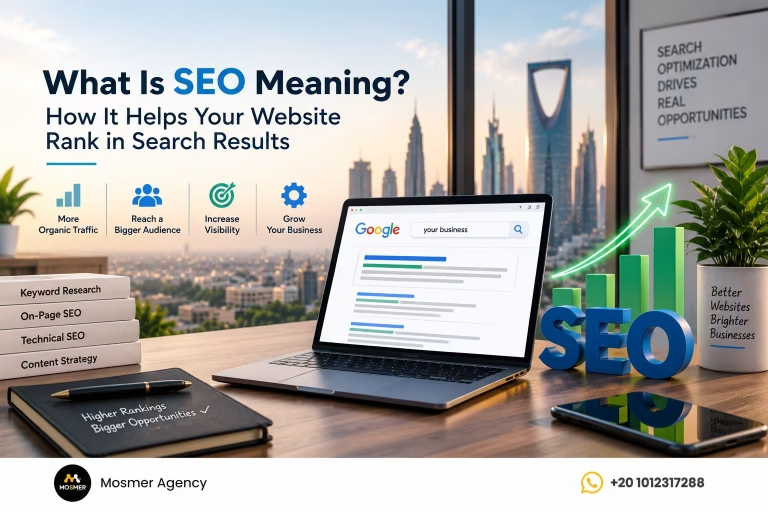
SEO stands for Search Engine Optimization.
At its core, SEO is a set of practices and strategies aimed at improving a website’s pages so that search engines like Google can better understand their content and evaluate how relevant they are to different search queries — increasing the chances of appearing in organic results.
The SEO meaning goes far beyond simply placing keywords inside articles. It’s a comprehensive discipline that includes several interconnected elements:
- Content: Providing useful, trustworthy information that matches what users are actually searching for.
- Keywords: Understanding the phrases your audience uses and targeting them naturally.
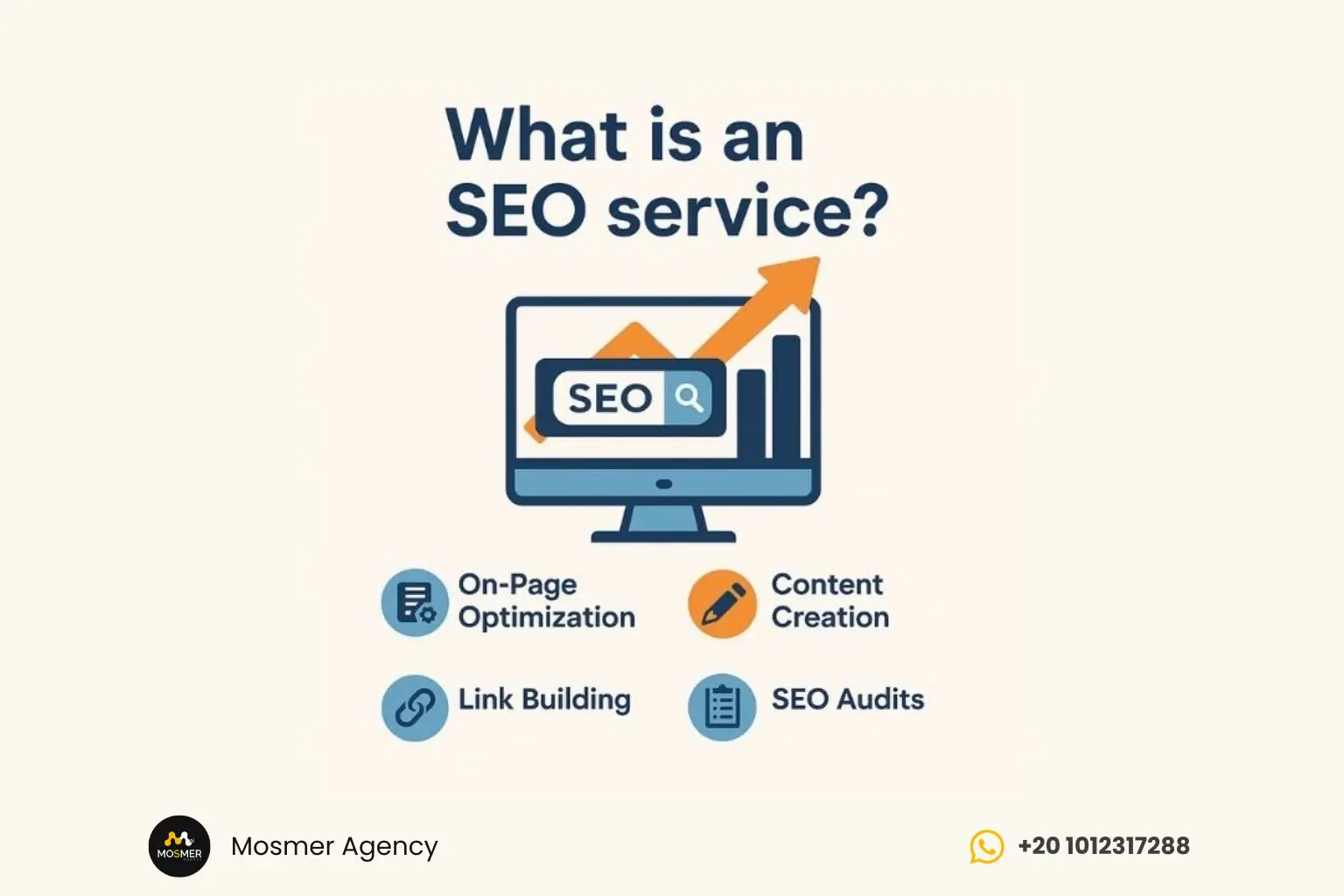
- On-page optimization: Structuring titles, content, internal links, and meta descriptions effectively.
- Technical SEO: Improving site speed, crawlability, indexing, site architecture, and mobile compatibility.
- Off-page signals: Building a credible digital presence and earning relevant, quality backlinks.
In short, the SEO meaning can be simplified as optimizing your website, its content, and its user experience to increase the chances of it appearing in front of the right audience in unpaid (organic) search results.
The real goal of search engine optimization shouldn’t just be ranking higher — it should be reaching users who have a genuine interest in what your website offers, and turning that visibility and traffic into real business value. That’s exactly the approach Mosmer Agency’s team focuses on.
Why SEO Matters for Improving Your Search Visibility
Having a website doesn’t automatically mean customers will find it. With so many websites competing for the same keywords, pages need continuous optimization to appear in front of their target audience.
The importance of SEO shows up in several key areas:
- Increased organic visibility: Search engine optimization helps improve the chances of your pages appearing in search results without paying for every click.
- Reaching your target audience: When you target the words and topics your audience is actually searching for, reaching potential customers becomes far more relevant to their needs.
- More qualified traffic: Appearing in front of a user who is already searching for a product or service you offer tends to attract more valuable visits than random traffic.
- Building brand trust: Consistently appearing in search results can strengthen your brand’s presence and increase audience recognition.
- Better user experience: Many SEO practices are directly tied to improving site speed, page organization, ease of navigation, and mobile compatibility.
- Long-term growth support: Well-optimized content and pages can continue attracting organic traffic well beyond the initial effort, with ongoing maintenance and updates.
But achieving these benefits doesn’t come from applying a few isolated SEO tactics — it requires a fully integrated strategy that starts with analyzing the website, the audience, and competitors, then identifying search opportunities, implementing improvements, and tracking results. This is the approach specialized SEO agencies like Mosmer can offer to help businesses build a stronger presence in search results.
From this perspective, SEO becomes part of a broader digital marketing strategy — not just a one-time set of edits made to a website.
Improve Your Search Visibility with Mosmer Agency
Get your business in front of customers actively searching for your products or services on Google. Our SEO strategies combine technical optimization, content, and keyword targeting to increase your visibility, attract qualified traffic, and create sustainable growth opportunities.
Contact us on WhatsApp and enjoy 50% off for website visitors.
How Search Engine Optimization Improves Your Website and Increases Traffic
Search engines analyze billions of pages to understand their content and determine how relevant they are to users’ search queries. The role of SEO is to help search engines discover, understand, and index pages, then optimize a range of elements that make the website more useful — both for users and for search engines.
The process of optimizing a website typically follows several interconnected steps:
- Understanding search intent: Identifying what the user is actually trying to accomplish with their query — whether they’re looking for information, a comparison, a product, or a service.
- Keyword research: Discovering the terms and phrases your audience uses and matching them to the right pages.
- Content optimization: Delivering clear, useful answers that cover the topic in appropriate depth, without unnatural repetition or filler.
- Site structure optimization: Organizing pages, headings, and internal links in a way that makes navigation and content relationships easy to understand for both users and search engines.
- Technical improvements: Making sure search engines can access and index pages properly, while paying close attention to performance and mobile experience.
- Building credibility: Supporting the website with relevant, quality external signals, when appropriate for the nature of the project.
When SEO is handled professionally, these steps aren’t executed in isolation — they’re prioritized based on the website’s current state, business goals, and competitive landscape. That’s why Mosmer Agency starts by analyzing the website, keywords, and competitors before identifying the priorities most likely to drive meaningful growth, ahead of implementation.
By executing these elements and consistently measuring results, a website can improve its visibility in search results — increasing the chances that interested users actually reach its pages.
To understand how search engine optimization works more broadly, you can check out our guide on What Is Search Engine Optimization (SEO)? A Complete Guide to Improving Your Website and Ranking on Google, which explains the most important elements of SEO and how to apply them to improve site performance in search results.
Main Types of SEO
SEO can be broken down into several core types, each playing a different role in improving a website’s performance.
1. On-Page SEO
This focuses on the elements within a website’s pages — titles, content, keywords, meta descriptions, internal links, and page structure.
The goal is to make each page clearer for both users and search engines, while delivering content that matches search intent.
2. Technical SEO
This covers the technical aspects that help search engines access, understand, and index a website. Examples include:
- Site speed and performance
- Mobile compatibility
- Site architecture and internal linking
- Sitemap and robots.txt files
- Resolving crawling and indexing issues
- Structured data, when used appropriately
3. Off-Page SEO
This focuses on signals that come from outside the website itself, such as backlinks and brand-related digital mentions.
The effectiveness of this type doesn’t depend on the number of links alone, but on their quality, relevance, and how naturally they were acquired.
4. Local SEO
This focuses on improving visibility for businesses among users searching for products or services within a specific geographic area.
It’s particularly important for businesses that serve specific cities or regions, such as restaurants, clinics, retail stores, and other local services.
SEO Techniques: White Hat, Gray Hat, and Black Hat
SEO practices differ based on how closely they align with search engine guidelines, which is why they’re typically grouped into three categories: white hat, gray hat, and black hat.
White Hat SEO
Relies on practices that comply with search engine guidelines and focus on delivering real value to the user — such as creating useful content, improving site structure, enhancing user experience, and targeting keywords in line with search intent.
This is the most sustainable approach, since it focuses on building genuine value for the website rather than attempting to manipulate rankings.
Gray Hat SEO
Falls somewhere between clearly acceptable practices and those that carry risk or conflict with search engine guidelines.
Some of these techniques may not appear directly harmful, but they can become risky when used with the intent to manipulate rankings — which is why they should be approached with caution and never treated as a substitute for a sustainable strategy.
Black Hat SEO
Relies on tactics designed to manipulate search results or exploit ranking system loopholes, such as keyword stuffing, large-scale unnatural link building, or hiding content from users.
These practices may deliver short-term results in some cases, but they carry significant risks, potentially leading to reduced visibility or manual penalties from Google.
For this reason, when choosing an SEO company, it’s best to confirm they follow a clear, sustainable strategy — rather than one that promises fast, unrealistic results.
Best SEO Practices to Improve Your Website’s Search Rankings
There’s no single formula that guarantees top rankings, but there are practices that consistently help build a website that’s more aligned with search engines and more useful to users. Among the most important:
- Create useful, original content: Write for the user first, providing clear answers and information that add real value — rather than producing content solely to target keywords.
- Understand search intent: Before creating any page, determine what the user is actually looking for — whether it’s an educational article, a service page, a product page, or a comparison.
- Use keywords naturally: Place your primary keyword and related phrases in the right locations, without overusing them or compromising the quality of the writing.
- Optimize titles and meta descriptions: Make page titles clear and descriptions compelling enough to encourage clicks, while accurately reflecting the page’s content.
- Organize content with subheadings: Breaking content into clear headings and short paragraphs helps users find the information they need more easily.
- Strengthen internal linking: Connect related pages logically to help both users and search engines discover content and understand your site’s structure.
- Improve performance and mobile experience: Ensure pages load quickly and work smoothly across devices, especially mobile phones.
- Fix crawling and indexing issues: Review pages facing access or indexing problems, and make sure search engines can discover your most important content.
- Update content when needed: Some topics change over time, so content should be reviewed and refreshed whenever information becomes outdated or inaccurate.
- Track performance with data: Use analytics and visibility tracking tools to understand which pages and keywords are performing well, and identify what needs improvement.
Most importantly, these practices work as an integrated system. Optimizing content alone isn’t enough if the site has technical issues, and strong technical performance can’t make up for a lack of useful content — a balance Mosmer Agency keeps in mind throughout every project.
Common SEO Mistakes to Avoid
Applying SEO incorrectly can waste time and budget, and in some cases, actually hurt a website’s performance instead of improving it.
Among the most common mistakes:
- Keyword stuffing: Artificially repeating a target keyword doesn’t make content better — it can actually damage user experience.
- Writing only for search engines: Content should serve the user and answer their needs, not just be packed with terms without offering real value.
- Copying content: Duplicate content, or content that adds no real value, won’t help a website build a strong, sustainable presence.
- Buying random links: Focusing on the number of links instead of their quality and relevance can expose a website to unnecessary risk.
- Neglecting technical SEO: Ignoring indexing issues, site speed, or page structure can limit the return on your content efforts.
- Targeting irrelevant keywords: You might generate a lot of traffic, but it won’t be valuable if it’s not related to what your website actually offers.
- Measuring success by ranking alone: Position in search results is an important indicator, but it’s not the only one — qualified traffic, conversions, and business goals matter more in the end.
- Expecting instant results: Search engine optimization is a cumulative process, and results vary depending on the website, competition, and strategy used.
A strong SEO strategy relies on continuous analysis and avoids shortcuts that chase quick wins at the expense of long-term sustainability.
SEO in 2026: How Artificial Intelligence Has Changed Search Engine Optimization
The rise of AI tools has reshaped both how content is created and how users search for information — making SEO strategy more dependent on content quality, usefulness, and clarity, rather than simply producing as many pages as possible.
In 2026, several points have become especially important to keep in mind:
- AI-generated content isn’t the goal in itself: AI tools can help with research, planning, or data processing, but the ultimate value of content still depends on its accuracy, usefulness, and originality.
- Search intent matters more than ever: As search engines evolve and provide more direct answers, understanding the question a user is actually trying to answer has become more important than simply matching keywords.
- Added value is essential: Content that merely rephrases existing information — without adding analysis, expertise, or useful examples — will struggle to compete.
- Content strategy needs updating: The goal is no longer to create one article per keyword, but to build interconnected topics that comprehensively address audience needs.
- The search journey has changed: Users may now get part of their answer directly from search results or AI tools, which means websites need to give clear reasons to visit their pages — such as specialized expertise, original data, tools, or details that generic answers simply don’t provide.
None of this means SEO has lost its importance — its role is simply evolving alongside how people discover information. That’s why businesses need a strategy that combines search engine optimization, high-quality content, and a real understanding of audience behavior, rather than relying on outdated tactics built around keyword repetition.
The Difference Between SEO and Paid Advertising
While both SEO and paid advertising aim to increase a business’s visibility to its audience, they work in fundamentally different ways.
SEO focuses on improving a website’s visibility in organic search results. There’s no cost per organic click, but investing in SEO typically involves strategy, content, technical improvements, and the resources needed to implement and maintain them.
Paid advertising, such as Google Ads, allows businesses to appear in paid ad placements in exchange for an advertising budget, offering quick access to a target audience.
Here’s a simplified comparison between the two:
- Speed of results: Paid ads can start driving traffic as soon as a campaign launches, while SEO typically takes time to build results.
- Type of visibility: SEO delivers organic visibility, while ads appear in designated paid placements.
- Sustainability: Traffic from ads depends on an active budget and campaign, while successful SEO pages can continue attracting traffic even after direct ad spend stops.
- Purpose: Ads can be used for quick reach and testing offers or markets, while SEO helps build long-term organic presence.
In many cases, choosing between SEO and paid advertising isn’t the best approach — combining both channels within a single strategy often delivers the best of both worlds.
Make Your Website More Visible in Search Results with Mosmer Agency
Search engine optimization isn’t a one-time step you complete and move on from — it’s an ongoing process that starts with understanding your website, market, and audience, then building the right strategy, implementing it, measuring results, and continuously refining it.
This is where Mosmer Agency’s SEO services come in — helping businesses build a stronger presence in search results and reach the audience most relevant to their products or services.
Mosmer’s strategy begins with analyzing your website, competitors, and keywords, then identifying growth opportunities and priorities — whether related to content, on-page SEO, technical elements, or off-page presence.
Mosmer’s search engine optimization services include:
- SEO analysis and auditing: Identifying technical issues, weak points, and optimization opportunities.
- Keyword research: Identifying the words and topics that align with your business and your audience’s search intent.
- On-page optimization: Improving titles, content, internal links, and core on-page elements.
- Technical SEO: Improving site structure and performance, and resolving crawling, indexing, and other technical issues.
- Content strategy: Creating or optimizing content that targets audience needs and relevant search opportunities.
- Competitor analysis: Studying competition in search results to uncover opportunities worth pursuing.
- Monitoring and reporting: Measuring performance and reviewing results to make data-driven optimization decisions.
The goal here isn’t just ranking higher for a specific keyword — it’s building a strategy that helps your website attract qualified traffic, increase its visibility, and support your business goals over the long term.
If you’re looking for an SEO agency that can help you understand your website’s opportunities and build a clear plan to improve its visibility, Mosmer’s team can start by analyzing your website’s needs and identifying the steps best suited to your business and target market.
Frequently Asked Questions About SEO Meaning
What does SEO mean?
SEO stands for Search Engine Optimization — a set of practices designed to improve how website pages appear in organic search results, helping websites reach users interested in the content, products, or services they offer.
What are the benefits of SEO for a website?
Search engine optimization helps increase a website’s chances of appearing in search results, attract more relevant organic traffic, improve user experience, and support a sustainable digital presence for the brand.
Does SEO only mean ranking first on Google?
No. Ranking is one of SEO’s goals, but it’s not the only measure of success. What matters most is reaching the right audience, attracting qualified traffic, and achieving your website’s actual goals — whether that’s a service request, a product purchase, or an inquiry.
How long does it take to see SEO results?
The timeline varies from one website to another, depending on competition, the site’s technical condition, content quality, domain authority, targeted keywords, and how quickly improvements are implemented. There’s no fixed timeframe or guaranteed result that applies to every website.
Can SEO work without advertising?
Yes. SEO focuses on organic results and doesn’t require paying per click. That said, combining SEO with paid advertising can help achieve different goals within a comprehensive digital marketing strategy.
Does using AI to write content hurt SEO?
Using AI itself isn’t what determines content quality. What matters most is that the content is useful, accurate, original, adds real value for the user, and complies with search engine guidelines. Content should always be reviewed and refined rather than published as unedited, automatically generated text.
Do businesses need a specialized SEO company?
Not necessarily in every case, but working with a specialized team can be valuable when a website is large, competition is high, there are technical or content issues requiring specialized expertise, or when a business wants to build a long-term SEO strategy.
How do I choose the best SEO company?
Start by reviewing the company’s experience, working process, range of services, case studies (if available), and how they report and measure results. Avoid companies that promise guaranteed first-page rankings or fast results without an actual analysis of your website and competition.
Sources:
- https://moz.com/beginners-guide-to-seo
- https://developers.google.com/search/docs
- https://www.searchenginejournal.com/seo/