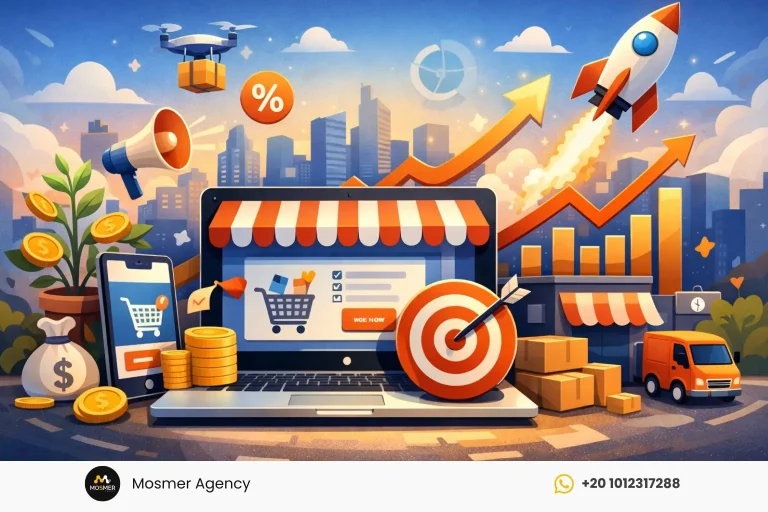
E-commerce is no longer just a modern trend—it has become the foundation on which most business models are built today. As consumer behavior continues to shift and more people rely on the internet to search and shop, the market has evolved from a limited local space into a constantly open, global marketplace.
In this environment, having an online store is no longer optional—it’s a competitive necessity. Businesses that fail to adapt risk missing real growth opportunities, while those that invest strategically unlock access to new markets and customers they could never reach before.
But here’s the real issue: many businesses enter the world of e-commerce with a single goal—selling. In reality, sales are just the outcome, not the full objective. True success doesn’t come from isolated actions, but from building an integrated system that combines growth, customer experience, operational efficiency, and profitability.
This is exactly where understanding e-commerce goals becomes critical—not as abstract ideas, but as a practical framework that guides every decision within your business.
Direct Answer Summary: E-commerce goals focus on achieving sustainable business growth by increasing sales, improving customer experience, enhancing operational efficiency, and maximizing profitability through technology and data. These goals go beyond selling products—they involve building a data-driven digital system that helps businesses understand customers, optimize performance, and make strategic decisions that support long-term expansion.
Table of Contents
What Are E-commerce Goals?
Simple Definition
E-commerce goals are the set of outcomes that an online business aims to achieve through digital channels, including sales, marketing, and customer engagement. These goals are not limited to generating revenue—they also include building lasting customer relationships and creating sustainable growth.
The real difference lies between random selling and strategic execution. Random selling relies on scattered efforts without long-term direction, while successful e-commerce businesses are built on clearly defined goals that guide every step—from product selection to website design and marketing campaigns.
Why Setting Goals Matters
Defining e-commerce goals is not just a theoretical exercise—it is the foundation of any successful online store.
First, it helps guide decision-making. With clear goals, it becomes easier to choose the right marketing channels, allocate budgets effectively, and develop products that align with business objectives.
Second, it enables accurate performance measurement. Without defined goals, there is no clear way to determine whether campaigns are successful or need adjustment.
Finally, it supports continuous improvement. Every metric becomes an opportunity for optimization, turning data into actionable insights rather than just numbers.
Core E-commerce Goals
Increasing Sales
One of the most important e-commerce goals is increasing sales by expanding your reach to more customers. Unlike traditional stores, an online store allows you to access a global audience without geographical limitations, creating far greater opportunities for growth.
Additionally, operating 24/7 means your store never stops selling. This allows you to capture demand at any time, regardless of time zones or business hours.
Expansion and Growth
E-commerce gives businesses a powerful advantage: scalability. An online store can grow without the need for heavy investments in physical locations or traditional infrastructure.
This flexibility enables businesses to enter new markets and target different customer segments using digital marketing tools. As a result, companies can increase their market share and strengthen their competitive position.
Improving Customer Experience
The success of any online store is not just about the number of visitors—it’s about the quality of the experience those visitors have.
Personalization plays a key role, allowing businesses to offer products and recommendations based on user behavior and interests. At the same time, a seamless buying journey—from fast browsing to a smooth checkout process—directly influences purchase decisions.
When customer experience improves, sales don’t just increase—customers become a continuous source of growth through repeat purchases and referrals.
Business Growth Goals in E-commerce
Increasing Market Share
A key e-commerce goal is expanding your presence in the market and reaching new customer segments. This doesn’t happen randomly—it requires the strategic use of digital marketing tools that allow precise audience targeting through ads, content, and social media.
Search Engine Optimization (SEO) also plays a critical role in this growth. It helps attract consistent organic traffic from users who are actively searching for your products or services, improving visibility and strengthening your position in a competitive market.
Improving Revenue
Increasing revenue is not just about driving more traffic—it’s about converting that traffic into paying customers.
This is achieved by improving conversion rates through optimized product pages, simplified user journeys, and clear, compelling offers.
At the same time, reducing cart abandonment is essential. This can be improved by streamlining the checkout process, minimizing steps, and offering multiple payment options.
Reducing Costs
E-commerce offers significant opportunities to reduce operational costs compared to traditional business models.
Many online stores rely on automation for order management, customer service, and marketing, reducing the need for constant manual intervention.
In addition, minimizing reliance on physical stores helps lower expenses such as rent and inventory management, ultimately improving overall profitability and efficiency.
Customer-Focused E-commerce Goals
Improving User Experience
User experience is the deciding factor between a visitor staying or leaving.
Easy access to products, fast website loading speed, and smooth navigation across pages all directly influence purchasing decisions.
In addition, real-time order tracking gives customers a sense of transparency and control, which builds trust and enhances their overall experience—making them more likely to return and purchase again.
Building Customer Loyalty
A customer should not be treated as a one-time transaction, but as a long-term relationship.
This can be achieved through email marketing, which maintains consistent communication with customers and delivers personalized offers.
Loyalty programs also play a key role by encouraging repeat purchases, turning customers into a continuous revenue source rather than a recurring acquisition cost.
Using Data Effectively
Data is the true engine behind any successful e-commerce strategy.
By analyzing user behavior, businesses can understand what attracts customers and what prevents them from completing a purchase.
Based on these insights, the experience can be personalized for each user—whether through tailored offers, product recommendations, or customized content—leading to higher engagement and improved conversion rates.
Operational Efficiency in E-commerce
Improving Processes
E-commerce thrives on speed and accuracy.
Fast, seamless transactions—from order placement to payment to delivery—enhance the customer experience while minimizing errors.
At the same time, data-driven decision-making enables continuous performance improvement, replacing guesswork with actionable insights.
Reducing Operational Costs
Compared to traditional retail, e-commerce offers significantly higher efficiency in resource management.
The absence of large physical spaces and the reduced need for extensive staff lower fixed costs. Meanwhile, digital systems streamline operations, making processes more organized and cost-effective.
Sustainability
Sustainability is becoming increasingly important in modern commerce.
E-commerce relies heavily on digital processes, which reduces overall resource consumption compared to traditional models.
Additionally, minimizing paper usage and optimizing inventory management contribute to building a more sustainable and future-ready business model.
Comparing E-commerce Goals
To get a clearer picture, the core e-commerce goals and their real-world impact can be summarized as follows:
| Goal | Main Impact | Practical Example |
| Increase Sales | Revenue Growth | A store operating 24/7 |
| Improve Experience | Customer Satisfaction | Personalized recommendations |
| Reduce Costs | Higher Efficiency | Process automation |
| Build Brand | Market Trust | Strong content & identity |
| Data Analysis | Better Decisions | Using Google Analytics |
This comparison highlights a key insight: success in e-commerce doesn’t rely on a single goal, but on the integration of multiple goals working together.
How to Set E-commerce Goals Effectively
Setting e-commerce goals correctly is what separates a business that grows consistently from one that operates without direction.
The first step is to apply SMART goals, ensuring that every objective is:
- Specific
- Measurable
- Achievable
- Relevant
- Time-bound
Next, define Key Performance Indicators (KPIs) such as conversion rate, customer acquisition cost, and average order value to measure performance accurately.
It’s also essential to align these goals with the overall business strategy, ensuring they support a clear vision for growth rather than existing in isolation.
Finally, goal-setting is not a one-time task. It requires continuous measurement and optimization, where results are analyzed and strategies are refined based on real data.
How These Goals Drive Sustainable Growth
When e-commerce goals are implemented correctly, they evolve from a simple plan into a powerful engine for growth.
First, they help build a long-term digital asset—including your website, content, and customer base—which continues to generate value even with reduced spending.
Second, they contribute to lower customer acquisition costs, as your store becomes more efficient at attracting the right audience instead of relying solely on paid ads.
Third, they lead to a higher return on investment (ROI) by improving performance across every stage of the customer journey.
Finally, they create a strong competitive advantage, enabling businesses to adapt faster, make smarter decisions, and stay ahead in a constantly evolving market.
Frequently Asked Questions (FAQ)
What are the most important e-commerce goals?
The most important goals include increasing sales, expanding customer reach, improving user experience, reducing costs, and building a strong brand. Together, these goals drive sustainable growth.
Is selling the only goal of e-commerce?
No. Sales are the outcome, not the only goal. E-commerce also focuses on building customer relationships, enhancing experience, and improving operational efficiency for long-term success.
How can I increase my online store’s sales?
You can increase sales by improving user experience, using effective digital marketing strategies, optimizing product pages, reducing cart abandonment, and targeting the right audience through data.
What is the role of SEO in e-commerce?
SEO helps drive organic traffic from search engines without ongoing ad costs, increasing visibility and attracting high-intent customers who are ready to buy.
How do I measure the success of an online store?
Success is measured using key metrics such as conversion rate, website traffic, average order value, customer acquisition cost, and customer retention rate.
How Can Mosmer Agency Help You?
Achieving e-commerce goals isn’t just about having an online store—it’s about building a clear, data-driven strategy rooted in real customer behavior.
At Mosmer Agency, we help businesses transform their online stores into complete growth systems. By combining SEO, performance marketing, and user experience optimization, we focus on delivering measurable, sustainable results—not just short-term wins.
If you’re looking to improve your store’s performance and increase your sales in a meaningful way, get in touch with us and discover how we can build a strategy tailored to your goals—and designed to scale your business with confidence.
Conclusion
E-commerce goals go far beyond quick sales. They are about building an integrated system that connects growth, customer experience, and operational efficiency into one cohesive strategy.
Real success starts with setting clear goals—and executing them through data-driven decisions and continuous optimization. When done right, your online store evolves from a simple sales platform into a powerful engine for sustainable growth and long-term competitive advantage.