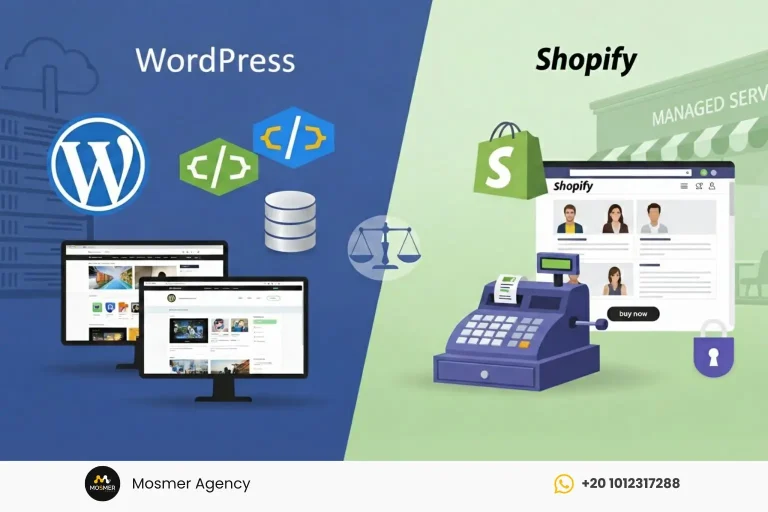
With the rapid growth of e-commerce, choosing the right online store platform has become a strategic decision that directly impacts cost, ease of management, and future scalability. That’s why the question of WordPress vs Shopify frequently arises among entrepreneurs and online store owners before launching their projects.
On one hand, WordPress is an open-source platform that offers full control and high flexibility. On the other, Shopify is a closed, fully managed platform that provides instant setup and built-in technical support. Understanding the difference between WordPress and Shopify is essential to determine which option aligns best with your needs, budget, and technical expertise. In this article, we break down WordPress vs Shopify in practical terms to help you make the right decision.
Direct Answer Summary: The main difference between WordPress and Shopify lies in how each platform is structured and managed. WordPress is an open-source system that can be turned into an e-commerce store using WooCommerce, offering high flexibility and customization but requiring hosting, setup, and ongoing maintenance. Shopify, on the other hand, is a closed SaaS platform built specifically for e-commerce, providing fast setup, built-in security, and technical support — though with less advanced customization flexibility. The best choice depends on your technical skills, budget, and long-term growth plans.
Table of Contents
What Is WordPress?
WordPress is an open-source content management system (CMS) used to build various types of websites, from blogs and corporate sites to fully functional e-commerce stores. By installing the WooCommerce plugin, WordPress can be transformed into a complete online store with product management, order processing, payment gateways, and shipping options.
One of WordPress’s biggest strengths is its flexibility and full control over design and functionality. With thousands of themes and more than 60,000 plugins available, users can customize almost every aspect of their website. This makes it an ideal choice for developers and business owners who require deep control over structure, performance, and user experience.
However, WordPress requires separate hosting, domain registration, theme and plugin installation, as well as regular updates and security management. As a result, it can be more complex for beginners compared to fully hosted solutions.
What Is Shopify?
Shopify is a closed, fully hosted e-commerce platform (SaaS) designed specifically for building online stores quickly and easily without advanced technical knowledge. It provides an intuitive dashboard, built-in hosting, automatic SSL certificates, and integrated payment systems, making the setup process fast and straightforward.
Shopify is known for its ease of use and 24/7 customer support, making it a popular choice for beginners and store owners who want to launch quickly without dealing with technical complexities.
However, customization in Shopify is limited to available themes and tools, and deeper modifications require working within Shopify’s proprietary system (Liquid). Since the platform operates within its own infrastructure, users have less control compared to WordPress.
Ease of Use & Setup: Which Is Actually Easier?
When comparing WordPress vs Shopify, ease of use is often the first factor considered—especially for new business owners without advanced technical skills.
Shopify: Fast and Instant Setup
Shopify offers a quick and straightforward setup experience. After creating an account, users can select a theme, add products, and connect payment gateways within a short time. There’s no need to purchase separate hosting or install external plugins to get started.
The dashboard is intuitive and easy to navigate, and 24/7 customer support is included. This makes Shopify an ideal option for beginners or anyone looking to launch an online store quickly without technical complications.
WordPress: Greater Flexibility with Added Complexity
In contrast, WordPress requires additional steps before launching a store, including:
- Purchasing hosting
- Registering a domain
- Installing WordPress
- Adding WooCommerce
- Choosing a suitable theme
- Configuring settings manually
While this process provides greater flexibility and control, it requires at least basic technical knowledge—or assistance from a developer. Ongoing updates and maintenance are also the responsibility of the site owner.
Conclusion on Ease of Use
If you’re looking for a quick, hassle-free solution, Shopify clearly wins in ease of setup.
However, if you’re willing to invest time and effort in exchange for full control and flexibility, WordPress offers broader customization possibilities.
Customization & Design: Which Platform Offers More Freedom?
When analyzing WordPress vs Shopify from a customization perspective, the discussion revolves around “freedom vs convenience.” Each platform delivers a very different experience in design control and feature flexibility.
WordPress: Nearly Unlimited Customization
WordPress offers an extremely high level of customization, especially when combined with WooCommerce. You can choose from thousands of free and premium themes, along with more than 60,000 plugins to extend functionality.
You can modify:
- Page designs entirely
- Store structure
- Checkout experience
- Product features
- Advanced functionality via custom plugins
Developers can also edit code directly (PHP, CSS, JavaScript), giving full control over every detail. This flexibility makes WordPress ideal for projects requiring deep customization or non-standard features.
However, this freedom comes with responsibility—regular updates, compatibility checks, and maintenance are required.
Shopify: Structured and Secure Customization
Shopify offers around 100 professionally designed themes optimized specifically for e-commerce. Customization is handled through built-in settings or Shopify’s proprietary Liquid language.
You can modify:
- Colors and fonts
- Section layouts
- Product page structure
- Certain features via third-party apps
Deep-level customization is more limited compared to WordPress because Shopify operates within a closed ecosystem.
The advantage is that everything is optimized to work smoothly and securely without complex technical management.
Conclusion on Customization
If you need full control and advanced customization, WordPress clearly has the advantage.
If you prefer a structured, ready-to-use system with limited but stable customization, Shopify offers a simpler experience.
Pricing & Costs: Which Is More Cost-Effective Long-Term?
When evaluating WordPress vs Shopify from a cost perspective, it’s important to look at the full picture—not just the monthly subscription. Each platform follows a different pricing model, and initial costs may not reflect long-term expenses.
Direct Comparison
| Aspect | WordPress (with WooCommerce) | Shopify |
| Initial Cost | Free + hosting (~$5/month) + optional plugins | $29/month (Basic plan) |
| Transaction Fees | Depends on payment gateway | Up to 2% extra without Shopify Payments |
| Long-Term Cost | Low if self-managed, higher with custom development | Fixed subscription + apps ($5–$50/month) |
| Product Limit | Unlimited (depending on hosting) | Unlimited |
WordPress: Flexible Cost Control
WordPress itself is free, but you’ll need:
- Hosting
- A domain
- A premium theme (optional)
- Paid plugins if needed
If you manage everything yourself (DIY), costs can remain relatively low. However, hiring developers or implementing advanced customizations can increase expenses significantly.
The advantage is full control over spending—you choose solutions based on your budget.
Shopify: Clear and Predictable Pricing
Shopify operates on a subscription model starting at $29 per month, including hosting, security, and support. However, you may need paid apps to expand functionality, increasing monthly expenses.
Transaction fees can also impact profitability if Shopify Payments is not used.
Conclusion on Pricing
If you want lower initial costs and full control over expenses, WordPress may be more suitable.
If you prefer a clear monthly fee without managing technical infrastructure, Shopify offers a more predictable pricing structure.
Security & Maintenance: Who Is Responsible?
When comparing WordPress vs Shopify, security and maintenance represent one of the most fundamental differences between the two platforms.
Shopify: Fully Managed Security
Shopify operates as a SaaS (Software as a Service) platform, meaning:
- Hosting is included
- SSL certificates are activated automatically
- Updates are handled automatically
- Payment systems are secured by the platform
- PCI compliance is maintained for payment processing
Users do not need to manage servers or worry about security patches. Everything is handled in the background by Shopify’s team, making it a convenient choice for store owners who want minimal technical involvement.
However, this also means less control over infrastructure since everything runs on Shopify’s servers.
WordPress: Full Control with Full Responsibility
With WordPress, you are responsible for:
- Choosing secure hosting
- Installing SSL certificates
- Updating the system and plugins
- Monitoring vulnerabilities
- Installing security plugins such as Wordfence
WordPress is not inherently insecure, but it can become vulnerable if updates are neglected or unreliable plugins are used.
The benefit is full control over your hosting environment and security setup—but it requires continuous monitoring and maintenance.
Conclusion on Security
If you want completely managed security with minimal effort, Shopify clearly has the advantage.
If you prefer full control over your technical infrastructure and are prepared to manage maintenance, WordPress offers greater autonomy.
SEO & Marketing: Which Platform Gives You Better Visibility?
When analyzing WordPress vs Shopify from a digital marketing perspective, search engine optimization (SEO) becomes a critical factor in driving organic traffic and reducing reliance on paid advertising.
WordPress: Clear Advantage in SEO & Content Marketing
WordPress is widely considered one of the strongest platforms for SEO, especially when using plugins like Yoast SEO or Rank Math. It provides full control over:
- URL structure
- Meta titles and descriptions
- XML sitemaps
- Structured data (Schema)
- Website speed and performance optimization
WordPress is also ideal for content-driven websites and blogs, making it highly suitable for content marketing strategies and long-term authority building.
This flexibility makes WordPress a powerful option for stores that rely on blogging, educational articles, or building an audience through search engines.
Shopify: Solid, Ready-to-Use SEO
Shopify offers built-in SEO features that are optimized by default, including:
- Automatic sitemap generation
- Optimized hosting speed
- Built-in SSL
- Structured URL formats
However, advanced SEO customization can be more limited compared to WordPress—especially when it comes to deep URL control or technical SEO adjustments.
Still, Shopify works well for stores focused primarily on paid advertising or those seeking faster results without complex technical management.
Conclusion on SEO
If your strategy relies heavily on content marketing and long-term organic visibility, WordPress provides a stronger advantage.
If you prefer a ready-made system with solid SEO basics and minimal technical adjustments, Shopify performs efficiently.
When Should You Choose Shopify?
After understanding the difference between WordPress and Shopify in terms of usability, customization, pricing, and security, the key question becomes: when is Shopify the better option?
Choose Shopify if you:
- Are a beginner with limited technical knowledge
- Want to launch a store quickly within days
- Use a dropshipping business model
- Target international selling with ready-to-use payment and shipping systems
- Prefer paying a fixed subscription for full management convenience
Shopify is ideal for entrepreneurs who want to focus on marketing and sales without dealing with hosting or technical maintenance.
When Should You Choose WordPress?
On the other hand, WordPress may be the better option if you:
- Need deep customization in design and functionality
- Have a limited budget and want full cost control
- Want to combine a store with a strong blog
- Rely on SEO and content as your primary growth strategy
- Plan long-term expansion with full control over infrastructure
WordPress suits projects that seek long-term flexibility—even if the setup process is more complex at the beginning.
Can You Combine WordPress and Shopify?
In some cases, entrepreneurs may start with Shopify to launch quickly and test the market, then later migrate to WordPress when they require deeper customization or a more advanced content strategy. This approach provides speed at the beginning and flexibility later.
However, combining both platforms—or migrating from one to the other—is not a simple decision and comes with challenges:
- Additional Costs: You may pay for a Shopify subscription initially, then invest in developing a new WordPress site later.
- Technical Complexity During Migration: Transferring products, customer data, orders, and URLs requires careful planning to avoid data loss.
- SEO Risks: Changing URL structures can negatively affect rankings if proper redirects are not implemented.
- Managing Two Systems: Running both platforms simultaneously (e.g., Shopify store + WordPress blog) can complicate integrations and analytics.
- Time & Resource Costs: Migration takes time and may shift focus away from marketing and growth efforts.
Ultimately, the decision is not about which platform is universally better—but which is better suited to your current stage and long-term growth plan. Strategic planning from the start can help you avoid costly transitions later.
Quick Decision Guide: Choose in 30 Seconds
If you’re still unsure after reviewing the WordPress vs Shopify comparison, here’s a quick guide to help you decide:
- Want to launch a store quickly without technical complexity? → Choose Shopify
- Need full control and advanced customization? → Choose WordPress
- Rely on content and SEO as your primary growth strategy? → WordPress is better
- Looking for convenience and fully managed security? → Shopify is more suitable
- Have a limited budget and want cost control? → WordPress
- Focused on dropshipping and fast global selling? → Shopify
Final Comprehensive Comparison: WordPress vs Shopify
To summarize the key differences between WordPress and Shopify clearly and concisely:
| Feature | WordPress (WooCommerce) | Shopify |
| Platform Type | Open-source | Closed (SaaS) |
| Ease of Use | Requires technical setup | Fast and easy setup |
| Customization | Nearly unlimited | Moderately limited |
| Cost Structure | Flexible (hosting + plugins) | Fixed monthly subscription |
| Security | Your responsibility | Fully managed security |
| SEO | Full and advanced control | Good but less flexible |
| Maintenance | Manual updates | Automatic updates |
| Best For | Hybrid sites + deep customization | Quick stores & dropshipping |
Which Platform Fits Your Growth Stage?
Choosing a platform isn’t just about features—it depends on your current business stage.
Early Launch Stage
If you’re just starting and want to test the market with minimal complexity, Shopify allows for fast execution without technical management.
Growth & Expansion Stage
If your store is scaling and you require deeper customization, advanced tools, or a stronger content strategy, WordPress may offer greater long-term flexibility.
Building a Complete Digital Brand
If your goal is to create a full digital ecosystem including a store, blog, service pages, and advanced SEO, WordPress provides broader structural control.
Common Mistakes When Choosing Between WordPress and Shopify
When comparing WordPress vs Shopify, some common mistakes can lead to poor decisions:
- Choosing based on price alone
- Ignoring long-term expansion plans
- Overlooking additional app costs in Shopify
- Underestimating maintenance requirements in WordPress
- Neglecting SEO strategy before selecting a platform
The right decision should be based on long-term vision—not just ease of getting started.
Frequently Asked Questions About WordPress vs Shopify
Which is better for beginners, WordPress or Shopify?
Shopify is easier to start with since it doesn’t require complex technical setup.
Which platform is stronger for SEO, WordPress or Shopify?
WordPress offers greater SEO control, especially for content-driven websites.
Is Shopify more expensive than WordPress?
Shopify has a clear fixed monthly cost, while WordPress may start cheaper but increase in cost with development and customization.
Can you migrate from Shopify to WordPress?
Yes, but it requires technical planning to avoid data loss or SEO issues.
How Can Mosmer Agency Help You?
Choosing between WordPress and Shopify is not just a technical comparison—it’s a strategic decision based on your business goals and long-term growth plan. At Mosmer Agency, we help you analyze your project requirements, select the most suitable platform, and build a professional, SEO-optimized store designed to generate real sales.
Whether you want to launch quickly with Shopify or build a highly customizable, scalable platform with WordPress, contact us to create an e-commerce solution that supports sustainable digital growth.
Conclusion
The difference between WordPress and Shopify is not about one being universally better than the other. It depends on your project type, technical expertise, budget, and future growth strategy.
WordPress provides unlimited flexibility and control, making it ideal for content-driven and long-term growth projects.
Shopify delivers simplicity, speed, and fully managed security, making it perfect for businesses that want to launch quickly without technical complexity.
The smart choice is the one that aligns with your strategy—not just the one that’s easiest to start with.
References
- Omnisend – Shopify vs. WordPress: Ultimate Comparison (2025)
- Charle Agency – Shopify vs WordPress: Which Ecommerce Platform (2026)
- Forbes Advisor – Shopify vs WordPress (Comparison)
- Arqqa – WordPress vs Shopify for Business in Egypt
- Website Builder Expert – Shopify vs WordPress (2026 Review)